


 Home
Home
Many people are trying to be more eco-friendly and curious about what materials can actually be recycled. SBS paperboard is widely used in packaging for food, cosmetics, and other products, but it often has a shiny coating. Does this coating make it hard to recycle? Can it go into regular recycling bins, or does it need special processing? Are there certain conditions or recycling centers that accept it more easily than others? Basically, is SBS paperboard something we can safely recycle without causing issues in the recycling process?
Is SBS Paperboard Recyclable? What You Need to Know
Related Encyclopedia
- 25086-18-4
- C8H8
- 104.14912
- All (33)
- China (14)
- (33)
- 9003-53-6
- [CH2CH(C6H5)]n
- 2.01588
- All (33)
- China (14)
- (33)
- 36290-94-5
- C12H13IO4
- 348.14
- All (0)
- China (0)
- (0)
- 88497-56-7
- (C10H13Br)n
- 213.11422
- All (24)
- China (8)
- (24)
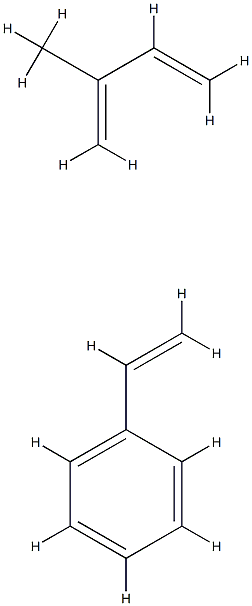
- 25038-32-8
- C13H16
- 172.26614
- All (0)
- China (0)
- (0)
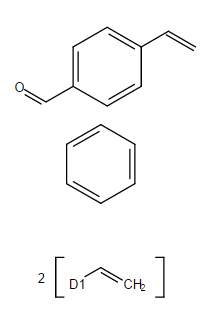
- 55279-75-9
- (C10H10.C9H8O)x
- 105.11000
- All (0)
- China (0)
- (0)
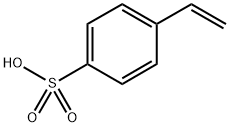
- 28210-41-5
- C8H8O3S
- 184.21
- All (2)
- China (2)
- (2)
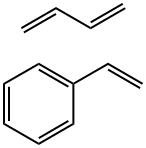
- 66070-58-4
- C12H14
- 158.24
- All (1)
- China (1)
- (1)
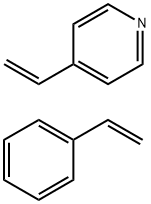
- 26222-40-2
- C15H15N
- 209.29
- All (0)
- China (0)
- (0)
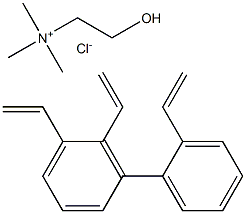
- 63181-94-2
- C23H30ClNO
- 371.9434
- All (0)
- China (0)
- (0)
Related Products More >

- CNY Request For Quotation
- CNY Request For Quotation
- 112945-52-5
- Request For Quotation
- 112945-52-5
- Request For Quotation
- 112945-52-5
- Request For Quotation
- 112945-52-5
- Request For Quotation
- USD 15.0000
- 25kg
- 980-26-7
- Request For Quotation


The recyclability of SBS paperboard aligns with the principles of circular economy in packaging engineering, where materials are designed to re-enter the production cycle after use. Its chemical composition allows it to undergo multiple recycling loops: during recycling, the paperboard is soaked in water to form a slurry, and mechanical processes separate the fibers from any remaining coatings or adhesives. These fibers can then be mixed with virgin pulp to produce new paperboard or other paper products, maintaining structural integrity up to a certain number of cycles. This stands in contrast to non-recyclable alternatives like certain laminated boards, which combine incompatible materials that cannot be efficiently separated, leading to contamination in recycling streams.
A common misconception is that the bleaching agents used in SBS production render it non-recyclable, but in reality, these agents are largely removed or neutralized during the initial manufacturing process. The residual chemicals are minimal and do not interfere with the recycling process, as modern recycling facilities are equipped to handle the slight pH variations that may arise. Another misunderstanding is that the smooth, glossy surface of SBS indicates a plastic coating, but this finish is often achieved through calendering— a mechanical process that compresses fibers— rather than non-recyclable additives. This distinction is crucial for waste management professionals, as misidentifying SBS as non-recyclable can lead to unnecessary disposal in landfills, undermining sustainability efforts in the packaging industry.
The recyclability of SBS paperboard depends on several factors, including the absence of non-paper coatings or laminations. Pure SBS, without additional layers like plastic or metallic finishes, is fully recyclable in standard paper recycling streams. The fibers in SBS are long and durable, allowing them to be reprocessed multiple times without significant degradation. However, when combined with barriers or coatings—such as polyethylene for moisture resistance—the recycling process becomes more complex, often requiring specialized separation techniques. For instance, a milk carton made of SBS with a plastic lining may need to be processed differently than a plain SBS cosmetic box.
In practice, the recycling infrastructure plays a crucial role in determining whether SBS paperboard is effectively recycled. Many municipal recycling programs accept uncoated SBS, but consumers must check local guidelines to avoid contamination. A real-world example is the luxury packaging industry, where brands increasingly opt for uncoated SBS or water-based coatings to ensure compatibility with recycling systems. This shift reflects a broader trend toward sustainable design, where material choices are weighed against end-of-life outcomes. The adaptability of SBS paperboard to recycling processes underscores its potential as a circular material, provided its composition aligns with recycling capabilities.
The recyclability of SBS paperboard depends on both its composition and the infrastructure of local recycling systems. In industrial settings, specialized recycling facilities can process coated paperboard by mechanically or chemically removing the polymer layer, allowing the cellulose fibers to be repurposed into new paper products. In contrast, conventional municipal recycling streams may reject heavily coated board because the coatings can contaminate batches, reduce paper quality, or clog processing machinery. This selective recyclability means that the environmental impact of SBS paperboard is context-dependent, highlighting the interplay between material design and waste management systems.
Beyond the technical aspects, the use of SBS paperboard carries broader implications in everyday life and industry. Its strength, printability, and barrier properties make it a preferred choice for products where aesthetics, hygiene, and durability are crucial. This popularity, however, also raises questions about sustainable material choices and circular economy strategies, as consumers increasingly demand packaging that is both visually appealing and environmentally responsible. Understanding the material’s chemical and physical behavior, alongside its processing limitations, enables better design decisions that balance performance with recyclability, ultimately influencing both industrial practices and household recycling habits.