


 Home
Home
Have you ever spilled epoxy resin on your wooden table or furniture and wondered how to get it off without ruining the wood? Maybe it’s hardened and scraping it feels impossible, or you’re worried about damaging the finish while trying to clean it. What’s the best way to tackle epoxy on wood, especially when it’s sticky or fully cured? Are there safe methods or household items that can help remove it without leaving marks or scratches? How do people usually handle this tricky situation so the wood stays intact?
How Can I Safely Remove Epoxy Resin from Wood Surfaces?
Related Encyclopedia
- 83873-16-9
- C22H28O4
- 356.46
- All (0)
- China (0)
- (0)
- 24969-06-0
- C3H5ClO
- 92.52
- All (27)
- China (14)
- (27)
- 38891-59-7
- C20H28ClNO4
- 381.9
- All (2)
- China (0)
- (2)
- 61788-97-4
- C21H23ClFNO2
- 375.8642232
- All (1)
- China (0)
- (1)
![3-[(E)-4,6-dimethylhept-2-enyl]oxolane-2,5-dione,2-[3-(oxiran-2-ylmethoxy)propoxymethyl]oxirane,4-(oxiran-2-yl)-7-oxabicyclo[4.1.0]heptane](https://chemcloud-1304660855.cos.ap-shanghai.myqcloud.com/compound/bbb16ce2863d42899585d90674283a10.png?imageMogr2/format/webp)
- 52368-54-4
- C30H48O9
- 552.69700
- All (0)
- China (0)
- (0)
- 67-64-1
- C3H6O
- 58.08
- All (22)
- China (16)
- (22)
- (C14H13NO)n
- 211.26000
- All (0)
- China (0)
- (0)
- 201058-08-4
- C15H16O2
- 228.28634
- All (0)
- China (0)
- (0)
- 28931-47-7
- C6H14N2O3
- 162.19
- All (0)
- China (0)
- (0)

- 11041-12-6
- C27H47N
- 385.66878
- All (0)
- China (0)
- (0)
Related Products More >

- 9002-86-2
- CNY Request For Quotation
- CNY Request For Quotation
- CNY Request For Quotation
- CNY Request For Quotation
- 465-42-11
- CNY Request For Quotation
- 465-42-10
- CNY Request For Quotation
- 465-42-9
- CNY Request For Quotation
- 96-26-4
- CNY Request For Quotation


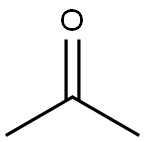
One common approach involves using heat to soften the epoxy. Applying a heat gun around 200-250°F gently softens the resin, reducing its adhesion so it can be scraped off carefully with a plastic or wooden tool to prevent wood damage. For smaller spills, acetone or specialized epoxy removers can be effective—though these require caution as they might affect the wood’s finish or color if left too long. Testing on a hidden area first helps mitigate unintended damage.
In practice, mechanical methods like sanding are often necessary for thicker layers. Starting with coarse-grit sandpaper and progressing to finer grits can restore the wood surface, though this risks altering its contour if done aggressively. For instance, removing an accidental spill on a wooden tabletop might combine gentle heating for bulk removal followed by light sanding to eliminate residues. Each step must balance efficacy with preserving the integrity of the wood substrate.
In practical terms, removing epoxy from wood involves exploiting its chemical and thermal vulnerabilities while minimizing damage to the substrate. Solvents like acetone or isopropyl alcohol can soften partially cured resin, allowing it to be wiped away. Heat can also temporarily reduce epoxy’s rigidity, making scraping feasible. Mechanical methods such as sanding or careful scraping work by breaking the polymer network, but excessive force risks gouging the wood or altering its surface texture. The interplay between chemical softening and physical removal highlights the need for a measured, controlled approach.
From a broader perspective, understanding epoxy removal on wood intersects with multiple disciplines. In woodworking, restoration, and furniture maintenance, removing epoxy without compromising aesthetics is crucial. In industrial settings, it informs practices for mold cleaning or surface preparation. The chemical principles involved—polymer cross-linking, solvent interaction, and thermal softening—also have parallels in materials science, adhesives engineering, and even biomedical applications where epoxy-like compounds are used in implants or coatings. Recognizing these cross-disciplinary aspects helps in selecting methods that are both effective and minimally invasive.
Practical considerations extend beyond chemistry. The porosity and finish of the wood, the type of epoxy used, and environmental factors like temperature and humidity all influence how easily the resin can be removed. Professionals often combine approaches—softening the resin chemically or thermally, then gently scraping or sanding—while monitoring the substrate to preserve its integrity. This balance between chemical manipulation and mechanical intervention demonstrates the nuanced understanding required for effective epoxy removal on wooden surfaces.
Mechanical methods, such as scraping with a sharp, non-abrasive tool or sanding with fine-grit paper, work by physically dislodging the resin, but they require precision to prevent gouging the wood. This is particularly important for finished or delicate wood surfaces, where preserving the wood’s texture and appearance is critical. Chemical removal, on the other hand, involves using solvents like acetone, methyl ethyl ketone (MEK), or specialized epoxy removers that break down the resin’s polymer chains. These solvents penetrate the resin, causing it to swell and lose adhesion, but they must be used in well-ventilated areas due to their volatility and potential toxicity.
A common misconception is that heat alone can effectively remove epoxy from wood; while moderate heat can soften some epoxy formulations, excessive heat can scorch the wood or cause the resin to char, making removal harder and damaging the surface. Instead, combining gentle heat with a solvent often yields better results, as the heat enhances the solvent’s ability to penetrate the resin. It’s also important to test any solvent or method on a small, inconspicuous area of the wood first, as some woods, especially those with natural oils or finishes, may react adversely to certain chemicals.
For cured epoxy that has fully bonded to the wood, especially in thick layers, a two-step approach is often necessary: first, using a scraper to remove as much of the bulk resin as possible, then applying a solvent to soften the remaining residue before wiping or sanding it away. This minimizes the amount of solvent needed and reduces the risk of overexposing the wood to harsh chemicals. Understanding the specific type of epoxy—whether it’s a standard bisphenol-A epoxy, a flexible epoxy, or a UV-cured variant—can also inform the choice of method, as different formulations may respond differently to solvents and mechanical stress.