


 Home
Home
Have you ever heard of an "express keratin treatment" at a salon and wondered what exactly it means? Is it just a faster version of a regular keratin treatment, or does it work differently on your hair? What chemicals are involved, and is it safe to use frequently? Also, how long does it last, and is it worth the cost compared to other smoothing treatments? Let's break it down—what is express keratin treatment really about?
What Is Express Keratin Treatment and How Does It Work?
Related Encyclopedia
- 50-00-0
- CH2O
- 30.03
- All (37)
- China (33)
- (37)

- 27848-81-3
- C3H5O3.Li
- 96.01
- All (37)
- China (33)
- (37)

- 8013-13-6
- CH2O
- 30.02600
- All (37)
- China (33)
- (37)
- 298-12-4
- C2H2O3
- 74.04
- All (46)
- China (16)
- (46)
- 6000-59-5
- C2H4O4
- 92.05080
- All (0)
- China (0)
- (0)
- 563-96-2
- C2H4O4
- 92.05
- All (12)
- China (8)
- (12)
- 3228-24-8
- CH2O
- 32.02570
- All (0)
- China (0)
- (0)
- 29881-90-1
- C9H20N2
- 156.26800
- All (0)
- China (0)
- (0)

- 36214-48-9
- C2H6N2
- 58.08240
- All (0)
- China (0)
- (0)
- 22418-64-0
- C11H24O2
- 188.30700
- All (0)
- China (0)
- (0)
Related Products More >

- 50-00-0
- Request For Quotation
- 50-00-0
- CNY 1000.0000
- 1ton
- 30525-89-4
- USD 80.0000
- 25kg
- 9003-35-4
- Request For Quotation
- 500g
- 9003-35-4
- Request For Quotation
- 25kg
- 9003-35-4
- Request For Quotation
- 500g
- 9003-35-4
- Request For Quotation
- 10g
- 9003-35-4
- Request For Quotation
- 100g


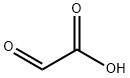
The process is pretty simple: the stylist applies a keratin-based formula to your hair, often with a mix of smoothing agents like glyoxylic acid or small amounts of formaldehyde. Then, they use heat (usually a flat iron) to seal it in. The result? Softer, shinier hair that’s less puffy and easier to style.
So if you're dealing with frizz and don't have time for the full treatment, this is a nice in-between option. It won’t make your hair pin-straight, but it does make your life a little easier. Want low-maintenance smoother hair without a full-day commitment? This might be it.
A defining feature of this treatment is its balanced formulation, which often contains lower concentrations of formaldehyde or formaldehyde-releasing compounds compared to older techniques, prioritizing hair health without compromising efficacy. For example, a client with coarse, curly hair may achieve sleeker results for 4-6 weeks, while someone with fine, wavy hair might enjoy extended frizz control. The express method is particularly effective for mid-porosity hair, as it optimizes protein absorption without overburdening the strands.
In practice, the treatment bridges convenience and performance. A stylist might recommend it for a busy professional seeking salon-quality smoothness between meetings or a traveler preparing for humid climates. However, post-treatment care—such as sulfate-free shampoos and avoiding saltwater—is crucial to prolong results. By combining scientific precision with real-world adaptability, the express keratin treatment exemplifies modern hair care’s evolution toward efficiency and customization.
At the core of the process lies the interaction between keratin molecules and the hair shaft's structure. Human hair is composed of keratin proteins arranged in a specific configuration of alpha helices and disulfide bonds. When hair is damaged—by heat, chemicals, or environmental exposure—these structural elements are weakened, leading to brittleness and frizz. The express keratin treatment applies hydrolyzed keratin (broken down into smaller fragments for better absorption) along with smoothing agents such as glyoxylic acid. Once heat is applied via a flat iron, these molecules bond temporarily to the hair’s cuticle and partially into the cortex, sealing gaps, aligning fibers, and creating a smoother surface through physical reconfiguration. Unlike traditional treatments that rely on formaldehyde-based crosslinking, express versions often use less aggressive chemistry, resulting in a subtler, more flexible finish.
From a broader interdisciplinary view, this procedure intersects with fields like polymer chemistry, cosmetic science, and dermatology. Its mechanisms demonstrate the reversible manipulation of protein structures under specific thermal and chemical conditions. In physics, this aligns with the concept of phase transitions and realignment under external stimuli. While its primary application is cosmetic, the underlying science reflects principles also used in biomaterials, protein engineering, and even drug delivery systems, where structural integrity and controlled binding play key roles.
In daily life, express keratin treatments help individuals manage textured or unruly hair with reduced reliance on styling tools, lowering long-term thermal damage. From an industrial standpoint, its development showcases how consumer demand drives safer, faster alternatives within cosmetic chemistry. The technique also reflects a growing preference for semi-permanent, adaptable beauty solutions that balance performance with health-conscious formulations. Understanding its basis allows for a more informed approach to hair care and provides insight into how molecular science translates into real-world benefits.
The mechanism relies on the protein’s ability to bond with the hair’s existing keratin, creating a protective layer that seals the cuticle, which is the outermost layer of the hair. This sealed cuticle reflects light better, giving hair a smoother, shinier appearance, and prevents moisture from penetrating excessively, which is a common cause of frizz. For instance, someone with wavy hair prone to frizz in humid weather might opt for an express keratin treatment. After the procedure, their hair would remain smoother and more manageable for several weeks, even in damp conditions, without the extended time commitment of a traditional treatment.
Practically, this makes express keratin treatments ideal for individuals with busy schedules who still want to improve their hair’s texture. Stylists apply the treatment, let it sit for a short period, then seal it in with a flat iron, which helps the keratin penetrate and set. The results are temporary, lasting around 4 to 6 weeks, depending on hair type and maintenance, such as using sulfate-free shampoos to preserve the treatment. This balance of convenience and effectiveness has made it a popular choice in professional hair care settings for those seeking quick, noticeable improvements.