


 Home
Home
I’ve been wondering about how gases behave in water, and methane came to mind. Since methane is a simple hydrocarbon and quite common in natural gas, does it actually mix with water, or does it stay separate like oil? Can it dissolve even a little bit, or is it completely insoluble? If it does dissolve, what makes that possible?
Will Methane Dissolve in Water?
Related Encyclopedia
- 32119-90-7
- DOT
- 22.02930
- All (50)
- China (13)
- (50)
- 20272-95-1
- DOT
- 21.02960
- All (50)
- China (13)
- (50)

- 358616-29-2
- H3O2
- 35.02260
- All (50)
- China (13)
- (50)
- 61468-85-7
- OT2
- 23.03120
- All (50)
- China (13)
- (50)
- 53774-37-1
- OT2
- 24.03130
- All (50)
- China (13)
- (50)
- 32113-92-1
- HOT
- 22.02320
- All (50)
- China (13)
- (50)
- 32119-89-4
- HOT
- 21.02310
- All (50)
- China (13)
- (50)
- 32113-93-2
- DOT
- 23.02930
- All (50)
- China (13)
- (50)
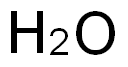
- 7732-18-5
- H2O
- 18.01
- All (50)
- China (13)
- (50)
- 263748-49-8
- C12H6Zr+
- 239.38400
- All (0)
- China (0)
- (0)
Related Products More >

- 101-68-8
- CNY Request For Quotation
- 101-68-8
- CNY Request For Quotation
- 101-68-8
- CNY Request For Quotation
- 149-44-0
- Request For Quotation
- 9003-05-8
- USD 30.0000
- 25kg
- 9003-05-8
- USD 30.0000
- 25kg
- 1336-21-6
- CNY 500.0000
- 1ton
- 74-82-8
- CNY 11000.0000
- 1ton


Even so, a tiny bit of methane can dissolve in water, but not very much at all. It’s so little that you wouldn’t even notice it in everyday life. This small amount happens mostly because gases can squeeze into the spaces between water molecules, but methane doesn’t stay long. So if you had a glass of water and added methane somehow, it wouldn’t really mix the way sugar or salt does—it would mostly escape back into the air.
You’ll actually see this in nature: lakes and ponds can hold small amounts of methane that comes from decaying plants underwater, but it eventually bubbles up to the surface.
The process is governed by Henry’s law, which states that the solubility of a gas in a liquid is proportional to its partial pressure above the liquid. At standard conditions, methane’s solubility in water is approximately 22 mg/L, which is negligible compared to gases like carbon dioxide that readily form chemical equilibria in water. Temperature and pressure influence this solubility; higher pressures, such as those in deep aquatic environments, allow more methane to dissolve temporarily, while higher temperatures reduce solubility.
From an environmental and industrial perspective, this slight solubility plays a role in natural methane cycling. Lakes and sediments often trap methane produced by anaerobic microorganisms, creating supersaturated zones where gas eventually escapes as bubbles. In industrial contexts, understanding methane solubility is crucial for natural gas processing, pipeline operations, and safety considerations, especially when preventing gas buildup in water systems. Furthermore, in the medical and environmental sciences, dissolved methane is significant for studying greenhouse gas emissions and their pathways from aquatic systems to the atmosphere. The limited solubility emphasizes methane’s tendency to remain in gaseous form, reinforcing its role as a major atmospheric greenhouse gas rather than a waterborne pollutant.
Understanding methane’s solubility in water also requires distinguishing it from polar or polarizable gases that exhibit higher solubility in aqueous environments. For example, carbon dioxide (CO₂), another greenhouse gas, has a solubility of roughly 1.45 grams per 100 milliliters of water at STP—far higher than methane’s. This difference arises because CO₂, while nonpolar overall, reacts with water to form carbonic acid (H₂CO₃), a process that is thermodynamically favorable and increases its dissolution. Ammonia (NH₃), a polar gas, dissolves even more readily (about 52.9 grams per 100 milliliters at STP) due to its ability to form strong hydrogen bonds with water molecules. Methane lacks both reactive functional groups and a dipole moment, so it cannot undergo such interactions, keeping its solubility negligible. In chemical engineering, this distinction guides the design of processes for gas separation or capture: for instance, systems intended to remove CO₂ from industrial emissions rely on its solubility in aqueous solvents, but similar approaches would fail for methane, requiring alternative methods like adsorption onto porous materials.
A common misconception about methane and water is assuming that methane’s presence in natural gas hydrates—ice-like structures found in permafrost and deep-sea sediments—indicates high solubility. In reality, gas hydrates form through a physical trapping mechanism, not dissolution. Under high pressure (typically above 3 MPa) and low temperature (below 10°C), water molecules form a crystalline lattice with voids that encapsulate methane molecules, stabilizing the gas in a solid state. This is distinct from dissolution, where individual gas molecules disperse uniformly in the solvent; in hydrates, methane remains as discrete gas pockets within the water-based lattice. This distinction is vital in geoscience, as it informs predictions about methane release from hydrates due to climate change: if methane were dissolved, it would be released gradually as temperatures rise, but since it is trapped in hydrates, destabilization can lead to sudden, large-scale emissions with more severe climate impacts.
In biological systems, methane’s low solubility in water shapes the behavior of methanogenic microorganisms—archaea that produce methane as a metabolic byproduct. These organisms are commonly found in anaerobic environments like wetlands, animal digestive tracts, and sewage sludge, where water is abundant. Since methane does not dissolve well in the surrounding aqueous medium, it is released as a gas, either escaping into the atmosphere or being consumed by methanotrophic bacteria (which oxidize methane for energy) before it can diffuse out. This process has implications for both ecosystem dynamics and greenhouse gas budgets: in wetlands, for example, the balance between methane production by methanogens and consumption by methanotrophs depends in part on how quickly methane gas can move through water—its low solubility ensures that it rises as bubbles rather than lingering dissolved, making it more accessible to methanotrophs near the water surface. Without this low solubility, methane would remain dissolved longer, reducing methanotrophic consumption and increasing atmospheric emissions from these ecosystems.
In practical contexts, this low solubility affects environmental and industrial systems. For instance, in aquatic ecosystems, methane released from sediments often forms bubbles and escapes to the atmosphere rather than dissolving completely. This behavior contributes to greenhouse gas emissions from wetlands or reservoirs. Similarly, in the energy sector, undissolved methane in pipelines or storage facilities can accumulate, posing safety risks such as combustion. Methane’s persistence in gaseous form underwater also informs mitigation strategies, like aeration in wastewater treatment to promote microbial oxidation before emission.
The partitioning of methane between water and gas phases follows Henry’s law, where its concentration in water remains proportional to its partial pressure in the adjacent atmosphere. This equilibrium-driven process explains why methane saturation in natural waters is typically low unless under high-pressure conditions, like in deep ocean environments or gas hydrates. Microbial activity in anoxic zones can produce dissolved methane, but even then, its tendency to effervesce prevails. Understanding these dynamics helps model climate interactions or design engineering controls where gas-water interfaces are critical.