


 Home
Home
Have you ever wondered how heavy or light methane gas is compared to air? We know methane is used for cooking, heating, and even as fuel in some vehicles, but how does its weight compare to the air around us? Does it float up or sink down if it escapes into the room? How does this property affect safety at home or in industrial settings? Why is it important to know methane’s specific gravity when dealing with gas leaks or storage? Could understanding this simple characteristic actually help prevent accidents or guide how we use it safely?
What Is the Specific Gravity of Methane and How Does It Affect Everyday Life?
Related Encyclopedia
- 118090-85-0
- C3+
- 36.03210
- All (95)
- China (15)
- (95)
- 141219-98-9
- C36
- 432.38500
- All (95)
- China (15)
- (95)
- 129066-02-0
- C9
- 108.09600
- All (95)
- China (15)
- (95)
- 139055-01-9
- C11
- 132.11800
- All (95)
- China (15)
- (95)
- 145270-74-2
- C17
- 204.18200
- All (95)
- China (15)
- (95)
- 145270-72-0
- C15
- 180.16000
- All (95)
- China (15)
- (95)
- 145270-70-8
- C13
- 156.13900
- All (95)
- China (15)
- (95)
- 7440-44-0
- C
- 12.011
- All (95)
- China (15)
- (95)

- 12595-79-8
- C2+
- 24.02140
- All (95)
- China (15)
- (95)
- 160208-69-5
- CHCl5
- 190.28400
- All (0)
- China (0)
- (0)
Related Products More >

- 7757-93-11
- CNY Request For Quotation
- 7757-93-10
- CNY Request For Quotation
- 7757-93-9
- CNY Request For Quotation
- CNY Request For Quotation
- CNY Request For Quotation
- CNY Request For Quotation
- 101-68-8
- CNY Request For Quotation
- 101-68-8
- CNY Request For Quotation


In practical applications, this specific gravity value shapes critical decisions across industries. In petroleum engineering, for example, methane— the primary component of natural gas— is often extracted alongside crude oil, and its low specific gravity (less than 1) means it is less dense than air. This property dictates how natural gas behaves in the event of a leak: instead of pooling near the ground (like denser gases such as propane, which has a specific gravity of ~1.52), methane rises and disperses into the atmosphere. This characteristic influences the design of safety systems in natural gas facilities, such as the placement of gas detectors (which are installed at higher elevations to catch rising methane) and ventilation strategies to prevent accumulation. In environmental science, understanding methane’s specific gravity relative to air also aids in modeling its transport in the atmosphere; since it rises, it interacts differently with upper atmospheric layers compared to denser greenhouse gases, affecting calculations of its global warming potential and atmospheric lifetime.
It is important to distinguish methane’s specific gravity from related properties like density and molar mass, as these terms are sometimes conflated. Density refers to mass per unit volume (e.g., g/L for gases), while specific gravity is a dimensionless ratio, eliminating the need to account for units when comparing substances. For instance, methane’s density at standard conditions is about 0.657 g/L, and air’s density is ~1.204 g/L; the ratio of these two densities (0.657 / 1.204 ≈ 0.554) matches its specific gravity relative to air, confirming that the two values are linked but not identical. Molar mass, meanwhile, is a measure of the mass of one mole of the substance, a fixed property of methane, whereas specific gravity can vary slightly with temperature and pressure (though the change is minimal under standard conditions). This distinction is vital in engineering calculations, where using the wrong property could lead to errors— for example, if a designer used molar mass instead of specific gravity to estimate gas dispersion, they would not account for the reference medium (air), leading to inaccurate predictions of how far a methane leak might spread.
Another potential point of confusion is the specific gravity of methane when in its liquid form, though this scenario is far less common in most industrial or environmental contexts. Liquid methane, which exists only at extremely low temperatures (around -161.5°C at 1 atm) or high pressures, has a specific gravity relative to water (at 4°C) of approximately 0.422, meaning it is less dense than water. This property is relevant in specialized fields like cryogenics or space exploration (where liquid methane is used as a rocket fuel), as it affects how the liquid is stored and transferred— for example, liquid methane would float on water, a consideration for spill response in cryogenic facilities. However, in most day-to-day applications, such as natural gas processing or residential heating, professionals focus on gaseous methane’s specific gravity relative to air, as this is the state in which methane is most commonly handled and encountered. Failing to clarify the phase (gas vs. liquid) when discussing methane’s specific gravity can lead to miscommunication, especially in cross-disciplinary projects where teams may have different assumptions about the substance’s physical state.
In practical applications, understanding methane's specific gravity is crucial for ventilation planning, leak detection, and storage in industrial settings. Because it rises, methane can accumulate near ceilings or enclosed upper spaces, making it vital to monitor these areas with sensors or alarms in places like factories, laboratories, and residential buildings that utilize natural gas. Its lightness also affects transport and pipeline design, influencing pressure requirements and flow dynamics. Beyond human-engineered systems, this characteristic impacts environmental science; for instance, methane released into the atmosphere contributes to greenhouse gas effects, and its buoyancy affects how it disperses in the air or water surfaces, influencing local and global climate models.
Methane's low specific gravity also intersects with health and safety disciplines. In confined areas, accumulation of methane can create an explosive hazard if mixed with oxygen and ignited. Understanding its tendency to rise allows engineers and safety professionals to design better evacuation routes, ventilation, and monitoring strategies. From an interdisciplinary perspective, this property connects chemistry, physics, environmental science, and occupational safety, highlighting how a single physical characteristic can have diverse applications. Knowing the specific gravity of methane not only informs practical engineering decisions but also provides insight into broader ecological and societal challenges, influencing how we manage energy resources, mitigate risks, and address climate considerations.
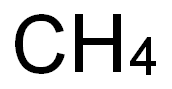
This low specific gravity arises from methane’s molecular structure—composed of one carbon atom and four hydrogen atoms (CH₄)—resulting in a low molecular weight of about 16 g/mol. In contrast, the average molecular weight of air is roughly 29 g/mol. The density difference explains why methane rises and dissipates quickly upward when released, rather than accumulating near ground level like heavier gases such as propane. This property directly influences safety protocols and engineering designs in industries handling natural gas, which is primarily methane.
In practical scenarios, methane’s lightness aids in leak detection and ventilation system design. For instance, in underground mines or confined spaces, methane accumulation near ceilings requires sensors placed at high points to detect potential explosions early. Similarly, in residential natural gas systems, its buoyancy allows safer dispersion outdoors, reducing immediate inhalation risks. These applications underscore how specific gravity informs both risk mitigation and operational efficiency in energy and safety sectors.