


 Home
Home
Hi, I’m curious about finishing options for my furniture. I’ve seen both lacquer and polyurethane used in stores and online, but I’m not really sure how they differ. I want to know which one might be better for durability, appearance, and ease of use. Are there specific situations where one is clearly preferable over the other? Can someone explain the main differences in a way that’s easy to understand for someone without a lot of experience?
What’s the Difference Between Lacquer and Polyurethane: Which Finish Should You Choose?
Related Encyclopedia
- 9009-54-5
- C3H8N2O
- 0
- All (13)
- China (0)
- (13)
![3-[(E)-4,6-dimethylhept-2-enyl]oxolane-2,5-dione,2-[3-(oxiran-2-ylmethoxy)propoxymethyl]oxirane,4-(oxiran-2-yl)-7-oxabicyclo[4.1.0]heptane](https://chemcloud-1304660855.cos.ap-shanghai.myqcloud.com/compound/bbb16ce2863d42899585d90674283a10.png?imageMogr2/format/webp)
- 52368-54-4
- C30H48O9
- 552.69700
- All (0)
- China (0)
- (0)
- (C14H13NO)n
- 211.26000
- All (0)
- China (0)
- (0)
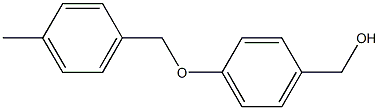
- 201058-08-4
- C15H16O2
- 228.28634
- All (0)
- China (0)
- (0)
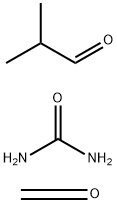
- 28931-47-7
- C6H14N2O3
- 162.19
- All (0)
- China (0)
- (0)

- 11041-12-6
- C27H47N
- 385.66878
- All (0)
- China (0)
- (0)
- 9003-74-1
- C10H18
- 0
- All (7)
- China (4)
- (7)
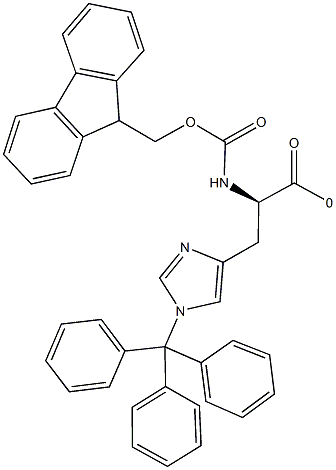
- 55844-94-5
- C40H32N3O3R
- 602.70038
- All (3)
- China (0)
- (3)

- 39319-11-4
- C18H15P
- 262.285461
- All (1)
- China (0)
- (1)
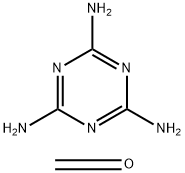
- 9003-08-1
- C4H8N6O
- 156.15
- All (1)
- China (1)
- (1)
Related Products More >

- 9002-86-2
- CNY Request For Quotation
- CNY Request For Quotation
- CNY Request For Quotation
- CNY Request For Quotation
- 465-42-11
- CNY Request For Quotation
- 465-42-10
- CNY Request For Quotation
- 465-42-9
- CNY Request For Quotation
- Request For Quotation


Polyurethane, in contrast, is a polymer-based finish that cures through a chemical reaction, forming a thicker, more resilient layer. It can be either water-based or oil-based, each with slightly different properties: water-based polyurethane dries faster and has lower odor, while oil-based versions provide a warmer tone and stronger durability. Polyurethane’s toughness makes it suitable for high-traffic surfaces such as hardwood floors, dining tables, and countertops. Its resistance to heat, moisture, and abrasion ensures long-term protection, even in demanding environments.
In practical terms, choosing between lacquer and polyurethane often depends on the balance between appearance and durability. For instance, a delicate wooden chair might benefit from lacquer to showcase fine detailing, while a heavily used kitchen table would perform better with polyurethane to withstand daily wear. Understanding the chemical basis of each finish helps woodworkers select the right product for specific applications and maintenance needs, ensuring both beauty and longevity.
From a physical standpoint, lacquer’s solvent-based curing produces a brittle film prone to scratching and yellowing over time, especially under UV exposure, a limitation mirrored in early plastic formulations that degraded in sunlight. Polyurethane, however, exhibits superior chemical resistance and flexibility, with water-based variants offering UV stability and oil-based types providing deeper penetration into substrates like wood. This durability makes polyurethane ideal for high-traffic surfaces such as floors, whereas lacquer’s rapid drying and ease of repair suit decorative applications like musical instruments or cabinetry, where frequent touch-ups are practical.
In industrial contexts, lacquer remains prevalent in automotive refinishing for its fast recoat times, enabling efficient production lines, while polyurethane dominates in aerospace coatings for its resistance to extreme temperatures and fuels. Medical applications further highlight these differences: lacquer-based coatings on surgical instruments prioritize smooth, non-reactive surfaces, whereas polyurethane’s biocompatibility and flexibility make it preferable for implantable devices. By aligning material properties with functional demands, these coatings exemplify how chemical engineering bridges performance gaps, ensuring solutions tailored to environmental, mechanical, and physiological challenges.
These structural differences drive key performance gaps. Lacquer dries extremely fast (touch-dry in 15–30 minutes, fully cured in 24 hours) due to its high-volatility solvents, making it ideal for projects requiring rapid turnaround (e.g., furniture assembly lines). However, its low cross-link density makes it less durable: it scratches easily, resists only mild solvents (e.g., water), and can yellow over time with UV exposure. Polyurethane, by contrast, cures more slowly (2–6 hours touch-dry, 24–72 hours fully cured for water-based; 4–8 hours touch-dry, 48–96 hours for oil-based) but offers superior protection. Its cross-linked network resists scratches, stains (e.g., wine, coffee), and harsh solvents (e.g., alcohol), and water-based variants are nearly UV-stable, avoiding yellowing—critical for light-colored woods (e.g., maple) or surfaces exposed to sunlight.
Application methods also differ due to their viscosity and drying rates. Lacquer is applied via sprayers (HVLP or airless) because its thin consistency and fast drying prevent brush marks; brushing lacquer leads to uneven coverage as solvents evaporate mid-application. Polyurethane, with higher viscosity, works well with brushes, rollers, or sprayers—its slower drying allows for smoother application and self-leveling, reducing imperfections. Additionally, lacquer requires multiple thin coats (4–6) to build sufficient thickness, as each coat is very thin; polyurethane needs fewer coats (3–4) due to its higher solids content and thicker cured film.
Common misconceptions blur these differences. One myth is that “lacquer is as durable as polyurethane”—in reality, lacquer’s lack of cross-linking makes it unsuitable for high-traffic surfaces (e.g., dining tables, floors), where polyurethane’s robustness is necessary. Another is that “water-based polyurethane is the same as water-based lacquer”—water-based lacquer still relies on resin coalescence (not cross-linking) and remains less durable than water-based polyurethane. Professionals select lacquer for decorative pieces (e.g., vintage furniture refinishing) where speed and a thin, “natural” look are prioritized, and polyurethane for functional surfaces where durability and stain resistance are non-negotiable. Understanding these chemical and performance distinctions ensures the right finish is chosen for each project, balancing aesthetics, speed, and long-term protection.