


 Home
Home
Hi, I’m curious about finishing painted surfaces. I recently painted a wooden table, and now I’m wondering if it’s possible to put polyurethane over the paint to protect it. Will the polyurethane stick properly, or could it cause peeling, bubbling, or discoloration? Are there specific steps I need to follow to make sure the finish looks smooth and lasts a long time? Is it safe to apply polyurethane directly over paint, or should I do some preparation first?
Can You Put Polyurethane Over Paint Without Ruining the Finish?
Related Encyclopedia
- 9009-54-5
- C3H8N2O
- 0
- All (13)
- China (0)
- (13)
![3-[(E)-4,6-dimethylhept-2-enyl]oxolane-2,5-dione,2-[3-(oxiran-2-ylmethoxy)propoxymethyl]oxirane,4-(oxiran-2-yl)-7-oxabicyclo[4.1.0]heptane](https://chemcloud-1304660855.cos.ap-shanghai.myqcloud.com/compound/bbb16ce2863d42899585d90674283a10.png?imageMogr2/format/webp)
- 52368-54-4
- C30H48O9
- 552.69700
- All (0)
- China (0)
- (0)
- (C14H13NO)n
- 211.26000
- All (0)
- China (0)
- (0)
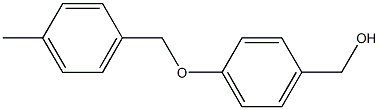
- 201058-08-4
- C15H16O2
- 228.28634
- All (0)
- China (0)
- (0)
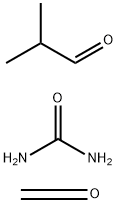
- 28931-47-7
- C6H14N2O3
- 162.19
- All (0)
- China (0)
- (0)

- 11041-12-6
- C27H47N
- 385.66878
- All (0)
- China (0)
- (0)
- 9003-74-1
- C10H18
- 0
- All (7)
- China (4)
- (7)
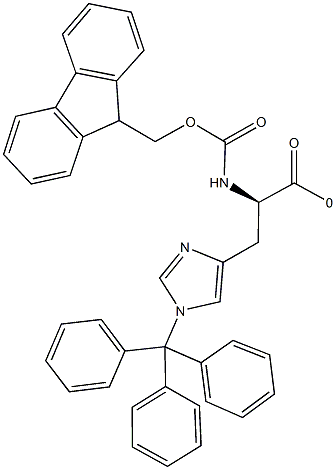
- 55844-94-5
- C40H32N3O3R
- 602.70038
- All (3)
- China (0)
- (3)

- 39319-11-4
- C18H15P
- 262.285461
- All (1)
- China (0)
- (1)
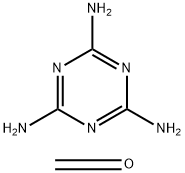
- 9003-08-1
- C4H8N6O
- 156.15
- All (1)
- China (1)
- (1)
Related Products More >

- 9002-86-2
- CNY Request For Quotation
- CNY Request For Quotation
- CNY Request For Quotation
- CNY Request For Quotation
- 465-42-11
- CNY Request For Quotation
- 465-42-10
- CNY Request For Quotation
- 465-42-9
- CNY Request For Quotation
- CNY Request For Quotation


Also, the type of paint matters—latex and acrylic paints generally work fine with polyurethane, but oil-based paints might take longer to cure before applying a protective layer. After applying, make sure each coat dries fully before adding the next one. With some patience, your painted surface will gain a strong, shiny finish that lasts for years without damaging the paint underneath.
To ensure proper adhesion, painters often lightly sand the painted surface. This mechanical abrasion creates micro-scratches that allow the polyurethane to “grab” onto the paint. For example, a wooden dresser painted with acrylic paint can gain enhanced durability and scratch resistance when polyurethane is applied on top, but skipping the sanding step could result in peeling or bubbling over time. Another consideration is the curing time of the underlying paint; fully cured paint prevents chemical interactions that might otherwise interfere with the polyurethane’s hardening process.
Different types of paint and polyurethane also influence outcomes. Oil-based polyurethane over water-based paint generally provides a tougher, glossier finish, whereas water-based polyurethane may be preferred over water-based paints for a more subtle sheen and faster drying. In practical settings, such as painting cabinets or furniture, following this sequence—curing, sanding, cleaning, and applying thin polyurethane coats—helps achieve a smooth, long-lasting protective layer. Even minor deviations, like skipping sanding or applying thick layers, can create visible defects, emphasizing the importance of understanding the materials’ chemistry and behavior in real-world applications.
Full paint curing is non-negotiable: latex paint needs 7–14 days to fully cross-link (beyond just feeling dry), as residual moisture or unreacted acrylic monomers can react with polyurethane’s components, causing bubbling or wrinkling. Oil-based paint cures slower, requiring 14–21 days, as its oxidation process continues long after surface dryness. Professionals test for cure by pressing a clean cloth over the paint—no transfer or tackiness means it’s ready. Light sanding with 220-grit sandpaper follows: this abrades the paint’s smooth top layer, creating micro-roughness that lets polyurethane’s reactive polyols and diisocyanates grip the surface. For latex paint, sanding also opens tiny pores in the acrylic network, enhancing mechanical adhesion; for oil-based paint, it breaks the hard alkyd film to expose reactive sites.
Water-based polyurethane is the safer universal choice: its water carrier won’t dissolve or soften latex paint, and its aliphatic diisocyanates bond well to sanded oil-based paint without yellowing the color. Oil-based polyurethane, however, should only be used over oil-based paint—its solvents can penetrate latex paint’s porous film, causing it to swell, bubble, or discolor as the acrylic polymer softens. A common misconception is that “all polyurethane works over any paint,” but using oil-based over latex often ruins the finish. Another myth is skipping sanding; without micro-roughness, polyurethane sits on the paint’s smooth surface, peeling off with minimal wear (e.g., a painted tabletop with un-sanded polyurethane may chip after a few months of use).
This process differs from applying polyurethane to bare wood, where the material penetrates natural pores; over paint, adhesion relies on mechanical grip from sanding and chemical bonding to the paint’s polymer network. By choosing water-based polyurethane for versatility, ensuring full paint cure, and sanding lightly, you create a cohesive finish that combines the paint’s color with polyurethane’s scratch and moisture resistance—critical for high-use items like cabinets, furniture, or trim, where the protective layer extends the paint’s lifespan while preserving its appearance.
From a material science perspective, adhesion depends on mechanical interlocking and chemical bonding. If the paint is fully cured and stable, light sanding with 220–400 grit paper creates micro-scratches, increasing surface area for the polyurethane to grip. This mirrors industrial coating processes, where abrasion enhances adhesion on metals or plastics. However, if the paint is oil-based or contains silicone additives, it may leave a residue that disrupts polyurethane wetting, akin to how hydrophobic coatings on medical devices resist protein adhesion. In such cases, a bonding primer containing polyisocyanates or silane agents can bridge the gap, forming covalent links between the paint and polyurethane.
In practical applications, water-based polyurethane is often preferred over oil-based variants for its lower odor and faster drying time, though oil-based polyurethane offers superior durability. For furniture or floors, applying thin, even coats with a high-quality brush or foam roller minimizes bubbles and streaks. This approach is critical in automotive refinishing, where multi-layer coatings must balance flexibility and hardness. Conversely, in medical settings, polyurethane over paint must avoid off-gassing volatile organic compounds (VOCs), highlighting the need for low-VOC formulations.
Cross-disciplinary insights reveal parallels in renewable energy, where polyurethane coatings protect wind turbine blades painted with anti-corrosive primers. The success of polyurethane over paint thus hinges on understanding material interactions at microscopic scales, ensuring that aesthetic enhancements do not compromise structural integrity or safety. By addressing these factors, the process transforms painted surfaces into resilient, functional finishes suitable for diverse environments.