


 Home
Home
Hi, I’ve been trying to figure out if it’s okay to mix wood stain directly with polyurethane. I know both are used to finish wood, but I’m worried that combining them might cause problems like uneven color, poor drying, or peeling later on. Is it safe to blend them together, or will it ruin the finish? Are there any special techniques I should know if I want to try this, and how long would it last compared to applying them separately?
Can You Mix Stain with Polyurethane Without Ruining Your Wood Finish?
Related Encyclopedia
- 9009-54-5
- C3H8N2O
- 0
- All (13)
- China (0)
- (13)

- 51811-82-6
- C14Cl1H14N3S1
- 291.8
- All (10)
- China (3)
- (10)
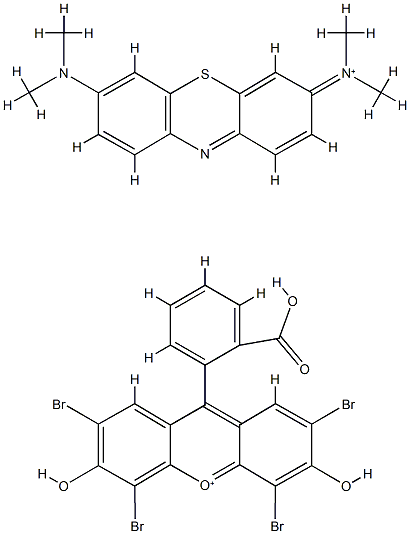
- 68988-92-1
- C36H27Br4N3O5S+2
- 933.29768
- All (6)
- China (2)
- (6)
![3-[(E)-4,6-dimethylhept-2-enyl]oxolane-2,5-dione,2-[3-(oxiran-2-ylmethoxy)propoxymethyl]oxirane,4-(oxiran-2-yl)-7-oxabicyclo[4.1.0]heptane](https://chemcloud-1304660855.cos.ap-shanghai.myqcloud.com/compound/bbb16ce2863d42899585d90674283a10.png?imageMogr2/format/webp)
- 52368-54-4
- C30H48O9
- 552.69700
- All (0)
- China (0)
- (0)
- (C14H13NO)n
- 211.26000
- All (0)
- China (0)
- (0)
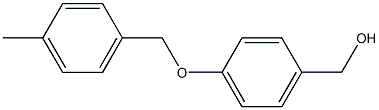
- 201058-08-4
- C15H16O2
- 228.28634
- All (0)
- China (0)
- (0)
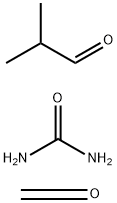
- 28931-47-7
- C6H14N2O3
- 162.19
- All (0)
- China (0)
- (0)

- 11041-12-6
- C27H47N
- 385.66878
- All (0)
- China (0)
- (0)
- 9003-74-1
- C10H18
- 0
- All (7)
- China (4)
- (7)
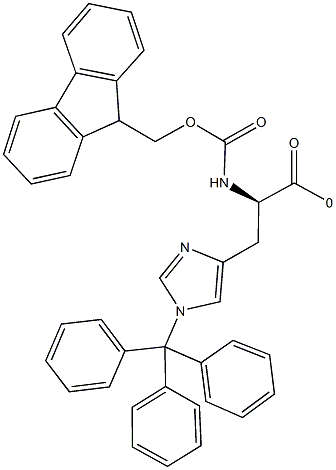
- 55844-94-5
- C40H32N3O3R
- 602.70038
- All (3)
- China (0)
- (3)
Related Products More >

- 9002-86-2
- CNY Request For Quotation
- CNY Request For Quotation
- CNY Request For Quotation
- CNY Request For Quotation
- 465-42-11
- CNY Request For Quotation
- 465-42-10
- CNY Request For Quotation
- 465-42-9
- CNY Request For Quotation
- Request For Quotation


When mixed correctly, the combination creates a “stain-sealer” that adds color and protection in one step, but this comes with trade-offs tied to their curing mechanisms. Stain solvents evaporate quickly to deposit pigments, while polyurethane solvents evaporate more slowly to allow cross-linking. Mixing them slows stain pigment penetration: the polyurethane’s thicker viscosity and slower-drying solvents reduce the stain’s ability to seep into wood pores, often resulting in a lighter, less uniform color than applying stain alone first. Additionally, the polyurethane’s reactive components can interact with stain pigments—some organic pigments in oil-based stains may react with isocyanates in polyurethane, dulling the color or causing uneven curing. For example, mixing a red oil-based stain with oil-based polyurethane might yield a muted pink hue instead of the intended red, as the isocyanates alter the pigment’s chemical structure.
Common misconceptions overstate the benefits of mixing. One myth is that “it saves time without sacrificing quality,” but the compromised pigment penetration and potential color distortion often require additional coats to achieve the desired look—undermining the time-saving goal. Another is that “any ratio works,” but professionals recommend a maximum of 1 part stain to 3 parts polyurethane; excess stain thins the polyurethane, weakening its cross-linked film and reducing scratch resistance. This differs sharply from applying stain then polyurethane sequentially: separate application lets stain fully penetrate (24–48 hours for oil-based, 12–24 hours for water-based) before polyurethane seals it in, preserving color depth while ensuring the polyurethane forms a dense, protective layer.
Mixing is only practical for low-stress, aesthetic-focused projects (e.g., small decorative items) where durability is less critical. For high-use surfaces like floors or countertops, sequential application is superior, as it leverages the stain’s ability to color wood deeply and the polyurethane’s ability to protect it fully. Understanding the chemical incompatibilities of oil and water systems, and the impact of mixed drying rates on pigment and film performance, ensures you avoid costly mistakes—like a cloudy, peeling finish—and choose the right method for your project’s needs.
In practical terms, one-step mixtures of stain and polyurethane are sometimes used for small projects like picture frames or trim, where color precision is less critical. For example, a woodworker might blend a small portion of oil-based stain with a compatible polyurethane to quickly finish a decorative box. However, for larger surfaces such as hardwood floors or furniture, applying stain first, allowing it to dry fully, and then applying multiple coats of polyurethane is more reliable. This method ensures consistent color saturation and a durable finish, as the protective layer adheres directly to the wood fibers rather than a partially mixed coating. Understanding these interactions helps professionals predict drying behavior, color outcome, and long-term durability, which is crucial for achieving high-quality wood finishes in both domestic and industrial applications.
From a chemical standpoint, compatibility hinges on solvent systems and curing mechanisms. Oil-based stains and polyurethane often share mineral spirits as a solvent, enabling partial miscibility. However, the pigment particles in stains can disrupt polyurethane’s uniform cross-linking, leading to uneven curing or a cloudy finish. This mirrors how impurities affect polymer synthesis in industrial plastics manufacturing, where contaminants weaken molecular bonds. Water-based variants face greater challenges, as their solvents may not evaporate uniformly, trapping moisture and causing blotchiness—a problem akin to phase separation in emulsion paints.
In practical applications, pre-mixed “stain-polyurethane” products exist, formulated to optimize pigment dispersion and curing. These products use controlled pigment sizes and additive packages to prevent settling while maintaining film flexibility. DIY mixes, while cost-effective, risk inconsistent results unless ratios are carefully calibrated. For instance, adding too much stain can reduce the polyurethane’s protective properties, compromising durability on high-traffic surfaces like floors. This trade-off reflects engineering principles where material performance is sacrificed for aesthetic customization.
Cross-disciplinary insights reveal parallels in biomedical coatings, where pigments are added to polymers for drug delivery or imaging contrast, requiring similar stability considerations. In automotive refinishing, tinted clear coats combine color and protection, but demand precise application techniques to avoid mottling. By understanding the interplay of chemistry, physics, and user intent, mixing stain with polyurethane becomes a deliberate design choice, balancing beauty and resilience in applications ranging from furniture to architectural finishes.