


 Home
Home
Hello, please. The answer is that calcium carbonate (CaCO₃) contains about 40% elemental calcium by mass. It's because calcium's atomic mass is 40, and in the compound's molar mass calculation, calcium accounts for 40 out of 100. Could you explain why this percentage is fixed, how to compute actual calcium in supplements, and what differences exist in calcium content between calcium carbonate and other calcium salts?
How Much Elemental Calcium Is in Calcium Carbonate? Breaking Down Its Content
Related Encyclopedia
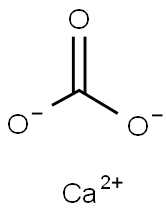
- 1317-65-3
- CCaO3
- 100.09
- All (868)
- China (56)
- (868)
- 792848-15-8
- CCaO3
- 100.08700
- All (868)
- China (56)
- (868)
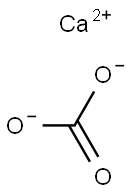
- 471-34-1
- CCaO3
- 100.0869
- All (868)
- China (56)
- (868)
- 15634-14-7
- CH2O3.Ca.6H20
- 208.17900
- All (0)
- China (0)
- (0)
Related Products More >

- 471-34-1
- CNY 50.0000
- 25kg
- 471-34-1
- Request For Quotation
- 1ton
- 471-34-1
- Request For Quotation
- 25kg
- 471-34-1
- Request For Quotation
- 1ton
- 471-34-1
- Request For Quotation
- 25kg
- 471-34-1
- Request For Quotation
- 1kg
- 471-34-1
- Request For Quotation
- 1ton
- 471-34-1
- Request For Quotation
- 25kg


To calculate actual calcium in supplements, multiply the product’s calcium carbonate mass by 0.4. For example, a 1,250 mg tablet provides 1,250 × 0.4 = 500 mg of elemental calcium.
Compared to other calcium salts, calcium carbonate has one of the highest elemental calcium contents (40%). In contrast, calcium citrate has ~21%, calcium gluconate ~9%, and calcium lactate ~13%. This makes calcium carbonate a more concentrated source, requiring smaller doses to meet daily needs.
1. Calcium Carbonate’s Elemental Calcium Content
•
Chemical Formula: CaCO₃
•
Molar Mass:
•
Calcium (Ca): 40.08 g/mol
•
Carbonate (CO₃): 60.01 g/mol
•
Total: 100.09 g/mol
•
Calcium Percentage:
100.09
40.08
×100%=40.04%(rounded to 40%)
Practical Example:
•
500 mg calcium carbonate tablet → 200 mg elemental calcium
•
1,250 mg dose (common antacid) → 500 mg elemental calcium
2. Calculating Actual Calcium in Supplements
Step-by-Step Method:
1.
Check Label: Identify total calcium carbonate mass (e.g., "1,000 mg CaCO₃").
2.
Apply 40% Rule: Multiply by 0.4 to get elemental calcium.
1,000mg×0.40=400mg elemental Ca
3.
Adjust for Bioavailability:
•
Calcium carbonate absorbs best with food (~30% absorption).
•
On empty stomach: Absorption drops to ~15%.
Real-World Scenario:
•
A 1,200 mg RDA for seniors requires:
0.40
1,200mg
=3,000mg CaCO₃ daily
(But split doses for better absorption!)
3. Comparing Calcium Salts: Key Differences
Calcium Form
Elemental Calcium %
Pros
Cons
Carbonate (CaCO₃)
40%
Cheap, high calcium density
Requires stomach acid; constipating
Citrate (Ca₃C₁₂H₁₀O₁₄)
21%
Absorbs without food; gentler
Lower calcium per pill
Gluconate (C₁₂H₂₂CaO₁₄)
9%
Mild on digestion
Very low calcium content
Lactate (C₆H₁₀CaO₆)
13%
Fast absorption
Rarely used alone
Absorption Efficiency:
•
Carbonate: 30% with food, 15% without
•
Citrate: 35-40% (food-independent)
•
Gluconate/Lactate: ~25-30%
This high calcium content makes calcium carbonate one of the most cost-effective and widely used sources of dietary calcium. It is commonly found in over-the-counter calcium supplements and antacids like Tums. However, it requires stomach acid for optimal absorption, so it is best taken with food.
In daily life, calcium carbonate’s high elemental calcium content benefits bone health, helping prevent osteoporosis, especially in older adults and postmenopausal women. It is also used in fortified foods such as plant-based milks and cereals to boost calcium intake.
Beyond nutrition, this property is useful in agriculture, where calcium carbonate in the form of limestone improves soil quality and provides calcium to crops. In construction, it strengthens materials like cement and concrete.
Because of its abundance, low cost, and high calcium yield, calcium carbonate remains a key source of elemental calcium across health, food, and industrial sectors. Keywords: calcium carbonate, 40% elemental calcium, molecular weight, calcium supplements, bone health, osteoporosis, Tums, fortified foods, agriculture, construction.