


 Home
Home
Wool carpets are beautiful but can be tricky to clean. How do you remove small spots without damaging the fibers or changing the color? Are there safe cleaners or household solutions that work for food, drink, or pet stains? How do you blot or treat the area without spreading the stain? Can temperature, water type, or scrubbing method affect the wool, and what’s the best approach for quick, safe spot cleaning at home?
How to Spot Clean Wool Carpet: Simple Tips for Everyday Stains
Related Encyclopedia
- 32119-90-7
- DOT
- 22.02930
- All (50)
- China (13)
- (50)
- 20272-95-1
- DOT
- 21.02960
- All (50)
- China (13)
- (50)

- 358616-29-2
- H3O2
- 35.02260
- All (50)
- China (13)
- (50)
- 61468-85-7
- OT2
- 23.03120
- All (50)
- China (13)
- (50)
- 53774-37-1
- OT2
- 24.03130
- All (50)
- China (13)
- (50)
- 32113-92-1
- HOT
- 22.02320
- All (50)
- China (13)
- (50)
- 32119-89-4
- HOT
- 21.02310
- All (50)
- China (13)
- (50)
- 32113-93-2
- DOT
- 23.02930
- All (50)
- China (13)
- (50)
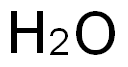
- 7732-18-5
- H2O
- 18.01
- All (50)
- China (13)
- (50)
- 12325-19-8
- H2O-
- 19.02320
- All (0)
- China (0)
- (0)
Related Products More >

- CNY Request For Quotation
- CNY Request For Quotation
- CNY Request For Quotation
- 9003-05-8
- USD 30.0000
- 25kg
- 9003-05-8
- USD 30.0000
- 25kg
- 1336-21-6
- CNY 500.0000
- 1ton
- 303-98-0
- CNY 40.0000
- 25kg


Work from the outside of the stain toward the center to avoid spreading it. After a minute or two, blot with a damp cloth to remove any soap residue. For oily stains, you can sprinkle a bit of baking soda or cornstarch first to absorb the grease before using the detergent.
Always let the area air dry and avoid hot water or harsh chemicals, because wool can shrink or lose color. With these steps, even tricky spills can be handled safely, keeping your wool carpet looking clean and fresh.
From a chemical perspective, wool’s isoelectric point—the pH at which the fiber carries no net charge—lies around 4.5–5.0. Using alkaline cleaners (pH > 7) can denature keratin proteins, causing fiber brittleness and color fading, a reaction akin to how over-bleaching damages hair. Conversely, acidic solutions (pH < 4) may swell the cuticle scales, trapping more dirt. Effective spot cleaners for wool thus maintain a near-neutral pH (6–8), often incorporating enzymes like protease to break down organic stains without chemical aggression, a principle borrowed from bioremediation technologies.
Physically, the process relies on capillary action and controlled evaporation. When applying a cleaning solution, the liquid wicks into the stain via capillary forces, dissolving contaminants. Blotting with a microfiber cloth—a material with fibers thinner than human hair—creates mechanical agitation at the nanoscale, lifting dirt without abrasion. Over-wetting must be avoided, as wool’s hygroscopic nature causes it to absorb up to 30% of its weight in water, risking fungal growth or dye bleeding if moisture lingers.
In industrial settings, similar principles guide the maintenance of woolen textiles in museums or high-end fashion, where preservation of historical dyes and fiber strength is critical. Medically, wool’s antimicrobial properties—due to lanolin and its scaly structure—make spot cleaning vital in healthcare environments to prevent pathogen accumulation without compromising fabric performance. By merging material science with gentle intervention strategies, proper wool carpet care exemplifies how microscopic fiber behaviors inform macroscopic maintenance practices, ensuring longevity in both domestic and specialized contexts.
The process begins with identifying the stain type to match the appropriate solvent. For water-based stains (e.g., coffee, juice), a mild, neutral detergent solution (pH 6–8) works by surrounding stain molecules, lifting them from the fiber’s surface without disrupting keratin’s structure. Applying the solution with a clean cloth, using gentle dabbing motions, prevents the stain from spreading and avoids over-wetting, which can lead to mildew growth in wool’s porous matrix—unlike synthetic fibers, which dry faster and resist microbial growth more effectively.
Oil-based stains (e.g., grease, wax) require a solvent like isopropyl alcohol, which dissolves lipids without interacting with wool’s protein bonds. It is critical to test the solvent on an inconspicuous area first, as some dyed wools may bleed; wool’s natural pigments are often less stable than synthetic dyes, making colorfastness a key consideration. After applying the solvent, blotting with a dry cloth draws the dissolved oil away, leveraging capillary action to remove residues from deep within the fiber.
A common misconception is that scrubbing aggressively improves results. This damages wool’s scales—tiny, overlapping structures on the fiber surface—causing them to interlock and create a matted appearance, a process known as felting. Similarly, using hot water accelerates keratin’s denaturation, leading to irreversible shrinkage, unlike with polyester, which is heat-resistant. Instead, using cool water and controlled pressure preserves the fiber’s integrity, ensuring the carpet retains its texture and durability while removing the stain.
The defining attributes of effective spot cleaning include pH-neutral solutions, appropriate dilution, and careful mechanical action. For instance, mild detergents or enzymatic cleaners can break down organic spills, while avoiding harsh chemicals that might damage the wool proteins. Blotting rather than rubbing prevents fibers from felting together and limits the spread of the stain. Temperature control is also essential: using cool or lukewarm water helps dissolve contaminants without causing shrinkage or color bleeding.
In practical applications, these principles guide homeowners and professionals alike. For example, if a wine spill occurs on a wool rug, sprinkling an absorbent powder first and then applying a diluted detergent solution with gentle blotting allows the stain to lift while maintaining the fiber integrity. Consistent application of these methods ensures that wool carpets remain both clean and durable, demonstrating how material science and cleaning techniques combine to produce effective real-world results.