


 Home
Home
Many people wonder if taking collagen can actually help with hair loss. Since collagen is known to support skin and joint health, can it also promote hair growth or prevent thinning? How does collagen work in relation to hair follicles, and are there any specific types or forms that are more effective? Is collagen a standalone solution, or should it be combined with other nutrients? What realistic benefits can people expect when using collagen for hair health?
Will Collagen Help with Hair Loss? What You Need to Know
Related Encyclopedia
- 68238-35-7
- 0
- All (3)
- China (1)
- (3)
- 9007-34-5
- 0
- All (14)
- China (1)
- (14)
- 9064-67-9
- C4H6N2O3R2.(C7H9N2O2R)n
- 0
- All (14)
- China (1)
- (14)

- 69430-36-0
- C2H2BrClO2
- 173.39308
- All (0)
- China (0)
- (0)
- 92113-31-0
- CO(NH2)2,Fe+++
- 0
- All (3)
- China (0)
- (3)
- 66451-70-5
- C13H14N2O3
- 246.26200
- All (0)
- China (0)
- (0)
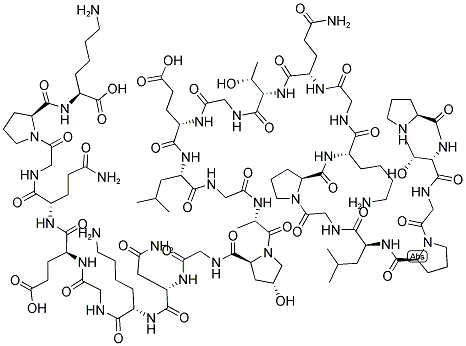
- 144703-90-2
- C106H174N32O37
- 2488.71
- All (0)
- China (0)
- (0)
Related Products More >

- 92113-31-0
- Request For Quotation
- 25kg/Cardboard Drum
- 92113-31-0
- Request For Quotation
- 1g,50g,100g,1000g
- 92113-31-0
- Request For Quotation
- 92113-31-0
- Request For Quotation
- 25kg/drum
- 92113-31-0
- Request For Quotation
- 92113-31-0
- Request For Quotation
- 92113-31-0
- Request For Quotation
- 92113-31-0
- Request For Quotation
- 100g;1kg;25g


Additionally, collagen metabolism produces amino acids that support keratin synthesis. Keratin, the primary protein in hair strands, relies on amino acids like cysteine, but its production is influenced by overall protein availability. Collagen-derived peptides may supplement the amino acid pool, aiding in the formation of strong, resilient hair shafts. However, unlike keratin, collagen lacks cysteine, a sulfur-containing amino acid essential for keratin’s disulfide bonds, so it cannot replace proteins rich in this nutrient.
A common misconception is that collagen directly stimulates hair growth. In reality, hair loss stems from diverse causes—hormonal imbalances, nutrient deficiencies, or autoimmune conditions—where collagen plays a secondary role. For example, androgenetic alopecia, linked to DHT sensitivity, is not addressed by collagen alone. Moreover, oral collagen must be broken down into peptides during digestion, and its contribution to follicle health depends on adequate absorption and the presence of co-factors like vitamin C, which supports collagen’s structural stability.
Thus, collagen may support hair health indirectly by reinforcing follicle infrastructure and providing amino acid building blocks, but it is not a standalone solution for hair loss. Its effectiveness is limited without addressing underlying causes, and it cannot replace targeted interventions for conditions driven by factors unrelated to structural support.
Mechanistically, collagen peptides absorbed through diet or supplementation are broken down into amino acids that the body can repurpose in biosynthetic pathways, including hair follicle regeneration and repair. Additionally, collagen contributes indirectly by maintaining skin elasticity and vascular health, which supports adequate blood flow and nutrient delivery to hair follicles. For example, individuals with aging or photo-damaged skin often experience reduced collagen production, which correlates with thinner hair and slower growth rates.
In practical terms, supplementing with collagen may improve scalp health and create a more favorable environment for hair growth, particularly when combined with other nutrients like biotin, zinc, and vitamin C, which play complementary roles in keratin production and collagen synthesis. While collagen alone is not a guaranteed treatment for all causes of hair loss, especially genetic or hormonal types, it can serve as a supportive element in comprehensive hair care and restoration strategies. Real-world applications include formulations combining collagen peptides with antioxidants and peptides designed to enhance follicular vitality.
From a biochemical perspective, collagen’s indirect effects on hair growth are mediated through its role in maintaining a healthy scalp microenvironment. The protein supports blood vessel integrity in the dermal papilla, the region responsible for nutrient delivery to follicles. Impaired collagen networks could disrupt blood flow, starving follicles of oxygen and essential nutrients like iron and zinc, which are critical for hair cycle regulation. Furthermore, collagen peptides may modulate inflammation by inhibiting enzymes like matrix metalloproteinases (MMPs), which degrade extracellular matrix components and are implicated in androgenetic alopecia. By stabilizing the dermal matrix, collagen could create a more favorable environment for follicle function.
Industrially, collagen’s biocompatibility has led to its use in hair care products, such as shampoos and conditioners, where hydrolyzed peptides aim to strengthen hair shafts and reduce breakage. In medical aesthetics, collagen-based fillers are sometimes used to improve scalp elasticity, though evidence for their efficacy in hair regrowth is limited. In daily life, the popularity of oral collagen supplements reflects a broader interest in holistic approaches to hair health, often combined with vitamins like biotin or vitamin D. However, critics note that systemic absorption of collagen does not guarantee targeted delivery to follicles, and excessive reliance on supplements may overlook underlying causes of hair loss, such as thyroid dysfunction or autoimmune disorders.
The broader significance lies in recognizing collagen as one piece of a complex puzzle. While it cannot reverse genetic hair loss patterns, its role in supporting scalp structure and nutrient delivery underscores its potential as an adjunct therapy. Integrating collagen with evidence-based treatments like minoxidil or finasteride, along with a nutrient-dense diet, may optimize outcomes. This cross-disciplinary perspective—spanning dermatology, nutrition, and material science—highlights collagen’s value not as a standalone solution but as a component of a multifaceted strategy to maintain hair health across the lifespan.