


 Home
Home
People often wonder whether dichloromethane, a common chemical used in labs and industry, can mix freely with water. Is it something that blends easily like sugar in tea, or does it separate and form layers? How does it behave when you pour it into water at home or in a lab setting? Are there situations where it might unexpectedly mix or stay apart? Basically, when it comes to liquids like dichloromethane and water, do they really get along, or do they keep their distance?
Is Dichloromethane Miscible in Water?
Related Encyclopedia
- 32119-90-7
- DOT
- 22.02930
- All (50)
- China (13)
- (50)
- 20272-95-1
- DOT
- 21.02960
- All (50)
- China (13)
- (50)

- 358616-29-2
- H3O2
- 35.02260
- All (50)
- China (13)
- (50)
- 61468-85-7
- OT2
- 23.03120
- All (50)
- China (13)
- (50)
- 53774-37-1
- OT2
- 24.03130
- All (50)
- China (13)
- (50)
- 32113-92-1
- HOT
- 22.02320
- All (50)
- China (13)
- (50)
- 32119-89-4
- HOT
- 21.02310
- All (50)
- China (13)
- (50)
- 32113-93-2
- DOT
- 23.02930
- All (50)
- China (13)
- (50)
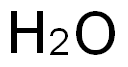
- 7732-18-5
- H2O
- 18.01
- All (50)
- China (13)
- (50)

- 3474-12-2
- CHCl2
- 83.92460
- All (30)
- China (24)
- (30)
Related Products More >

- 9003-05-8
- USD 30.0000
- 25kg
- 9003-05-8
- USD 30.0000
- 25kg
- 1336-21-6
- CNY 500.0000
- 1ton
- 75-09-2
- CNY 15.0000
- 25kg
- 75-09-2
- USD 125.0000
- 250kg


If you want, I can also make an even more casual, story-like version that’s super easy to picture. Do you want me to do that?
This physical behavior has practical implications in various domains. In industrial processes, dichloromethane is widely used as a solvent for paints, adhesives, and degreasing agents, where its limited miscibility with water allows for efficient separation and recovery. In laboratory settings, this property is exploited in liquid-liquid extractions to isolate compounds from aqueous solutions, taking advantage of the density difference and immiscibility. The inability to mix with water also affects environmental management, as accidental spills lead to dichloromethane forming pools that are not easily diluted or dispersed in natural water bodies, posing both ecological and occupational hazards.
From a chemical safety and physiological perspective, dichloromethane’s behavior in water informs exposure risks. Because it does not readily mix, ingestion or inhalation exposure routes differ in impact compared to more water-soluble compounds. Its volatility means that in enclosed spaces, vapors can accumulate even if small amounts are in contact with water, necessitating careful handling. Across disciplines, understanding dichloromethane’s solubility profile helps chemists, engineers, and environmental managers predict interactions with aqueous systems, design separation processes, and implement appropriate safety measures.
Its characteristics also highlight broader principles of chemistry: the interplay between polarity, hydrogen bonding, and density governs miscibility, and these fundamental ideas influence countless practical applications, from chemical synthesis to environmental monitoring. In essence, dichloromethane exemplifies how molecular structure and physical properties together determine behavior in mixed-phase systems, guiding both practical use and risk assessment.
In practical applications, this limited miscibility influences DCM’s behavior in environmental and industrial settings. For instance, when DCM is used as a degreasing agent or paint stripper, its immiscibility with water allows it to form separate layers, facilitating recovery in wastewater treatment processes. However, trace amounts dissolved in water can persist, posing ecological risks due to its volatility and potential toxicity. This property also impacts laboratory workflows, where DCM-water mixtures require careful separation techniques like rotary evaporation or liquid-liquid extraction.
The interplay between DCM and water’s polarity is further illustrated in organic synthesis. During reactions like phase-transfer catalysis, DCM’s ability to dissolve organic compounds while maintaining minimal water solubility enables efficient partitioning of reactants between aqueous and organic phases. This selective solubility is exploited in pharmaceutical manufacturing to isolate intermediates or purify products. Despite its utility, DCM’s environmental persistence underscores the need for alternatives in green chemistry, where solvents with higher water miscibility and lower toxicity are prioritized.
In practical terms, this immiscibility is critical in various chemical processes, such as liquid-liquid extraction, where dichloromethane’s ability to dissolve nonpolar and moderately polar compounds while remaining separate from water allows for the selective separation of solutes. For instance, in organic synthesis, reaction products that are more soluble in dichloromethane can be extracted from an aqueous reaction mixture by adding the solvent, shaking to allow partitioning, and then draining the lower dichloromethane layer—its higher density compared to water ensures this separation is straightforward. This behavior contrasts with solvents like ethanol or methanol, which are miscible with water due to their ability to form hydrogen bonds through their hydroxyl groups, enabling them to mix uniformly in all proportions.
A common misconception might arise from dichloromethane’s polarity; while it is more polar than nonpolar solvents like hexane, its polarity is not sufficient to overcome the strong intermolecular forces in water. Even though both substances are polar, the specific type of polarity and the absence of hydrogen bonding in dichloromethane prevent miscibility. This distinction is important in laboratory settings, where choosing the right solvent for a task depends on understanding such interactions—using dichloromethane when a water-miscible solvent is needed would lead to inefficiencies or failed separations, highlighting the practical relevance of this solubility property.