


 Home
Home
Hi, I'd like to ask—What is an ion exchange resin, especially the ones made with polystyrene? What does its structure look like? How does it swap ions in water or other solutions? Can it be reused after processing? Is it mainly used to purify water? Thanks!
What is an ion exchange resin, particularly those based on polystyrene, and how does it work?
Related Encyclopedia
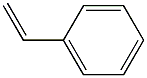
- 25086-18-4
- C8H8
- 104.14912
- All (33)
- China (14)
- (33)
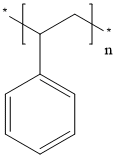
- 9003-53-6
- [CH2CH(C6H5)]n
- 2.01588
- All (33)
- China (14)
- (33)
- 64742-16-1
- 0
- All (35)
- China (13)
- (35)
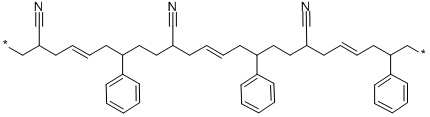
- 9003-56-9
- C45H51N3X2
- 633.91
- All (21)
- China (1)
- (21)
- 32119-90-7
- DOT
- 22.02930
- All (50)
- China (13)
- (50)
- 20272-95-1
- DOT
- 21.02960
- All (50)
- China (13)
- (50)

- 358616-29-2
- H3O2
- 35.02260
- All (50)
- China (13)
- (50)
- 61468-85-7
- OT2
- 23.03120
- All (50)
- China (13)
- (50)
- 53774-37-1
- OT2
- 24.03130
- All (50)
- China (13)
- (50)
- 32113-92-1
- HOT
- 22.02320
- All (50)
- China (13)
- (50)
Related Products More >

- 9003-05-8
- USD 30.0000
- 25kg
- 9003-05-8
- USD 30.0000
- 25kg
- 1336-21-6
- CNY 500.0000
- 1ton
- USD 15.0000
- 25kg


The structure is similar to a sponge with small pores, where the crosslinked polystyrene creates a three-dimensional matrix. Charged groups like sulfonic acid (for cation exchange) or quaternary ammonium (for anion exchange) hang from the matrix, waiting to attract opposite-charged ions.
When placed in a solution, the resin swaps ions. A cation exchange resin with H+ ions, for example, releases H+ and takes in positive ions like calcium or magnesium from hard water. An anion exchange resin with OH- ions swaps them for negative ions such as chloride or sulfate, continuing until the resin’s charged sites are full.
Polystyrene ion exchange resins can be reused through regeneration. Cation resins are soaked in a strong acid like hydrochloric acid to flush out collected cations and reload H+ ions. Anion resins use a strong base like sodium hydroxide to replace captured anions with OH- ions, restoring their ion-exchange ability.
While water purification is a key use—softening hard water or removing heavy metals—these resins also work in industrial chemical purification, medical dialysis, and lab ion separation. Their ability to target specific ions, based on their charged groups, makes them versatile across many applications.
The microscopic structure of these resins resembles tiny beads, typically measuring between 0.3 to 1.2 mm in diameter. Their internal architecture features numerous interconnected pores that allow solution molecules and ions to penetrate deeply into the polymer matrix. The functional groups responsible for ion exchange are attached to the polymer chains within these pores. Cation exchange resins usually feature negatively charged sulfonate (-SO₃⁻) or carboxylate (-COO⁻) groups, while anion exchange resins contain positively charged quaternary ammonium (-N⁺(CH₃)₃) or tertiary amine groups.
The ion exchange mechanism operates through electrostatic attraction and displacement. When a solution containing target ions contacts the resin, the functional groups on the resin surface interact with these ions. For instance, in a water softening application, calcium (Ca²⁺) and magnesium (Mg²⁺) ions in hard water displace sodium ions (Na⁺) attached to the resin's sulfonate groups. This exchange continues until the resin becomes saturated with the incoming ions. The process remains reversible, enabling regeneration by washing the resin with a concentrated solution of the original exchangeable ions - typically strong acids for cation resins and strong bases for anion resins.
Regeneration restores the resin's ion exchange capacity by flushing out accumulated ions and replenishing the functional groups. Cation resins are typically regenerated with hydrochloric acid (HCl) or sulfuric acid (H₂SO₄), while anion resins require sodium hydroxide (NaOH) or potassium hydroxide (KOH). Although the regeneration process can be repeated many times, each cycle gradually degrades the polymer structure, ultimately limiting the resin's lifespan.
While water treatment remains the most prominent application, these resins serve numerous other purposes. They play crucial roles in chemical processing for metal separation, pharmaceutical manufacturing for compound purification, food and beverage industries for decalcification, and nuclear facilities for radioactive ion removal. Specialized resin formulations can target specific ions such as heavy metals, nitrates, or perchlorate, making them indispensable in environmental remediation and various industrial processes. The ability to customize the resin's chemical properties for particular applications has established it as a versatile tool across multiple sectors.
The structure of these resins can be either gel-type or macroporous. Gel-type resins have a microporous structure and are known for their high ion exchange capacity. Macroporous resins, on the other hand, have larger pores, making them more effective for treating solutions with high levels of contaminants. The choice between these types depends on the specific application and the nature of the solution being treated.
The ion exchange process involves the substitution of ions in a solution with ions from the resin. For example, in water softening, a cation exchange resin with sulfonic acid groups (R-SO3Na) exchanges sodium ions (Na+) for calcium (Ca2+) or magnesium (Mg2+) ions present in hard water. This exchange effectively removes the hardness-causing ions, resulting in softened water. The displaced ions are then released into the solution, while the resin retains the exchanged ions.
One of the key advantages of ion exchange resins is their ability to be regenerated and reused. After the resin has exchanged its ions and becomes exhausted, it can be regenerated by passing a solution containing the original ions through it. For instance, a cation exchange resin used in water softening can be regenerated using a sodium chloride solution. This process displaces the accumulated hardness ions (Ca2+, Mg2+) and restores the resin to its original state, allowing it to be reused multiple times.
While ion exchange resins are primarily associated with water purification and softening, their applications extend beyond this. They are used in various industrial processes, including the separation of specific elements and the treatment of industrial wastewater. The selective ion exchange capability of these resins makes them valuable tools in processes where the removal or replacement of specific ions is necessary.
In water or other solutions, these charged groups attract ions of opposite charge. For instance, a resin with negative sites might pull positive ions such as calcium from hard water, releasing hydrogen or sodium ions instead. The cross-links keep the beads from breaking, while the pores let ions move through and bind to the functional groups.
Once the resin is saturated, it can be reused by treating it with a concentrated solution of the ions it initially released. This displaces the collected ions, resetting the resin. While water purification is a key use, they also help in recovering metals or treating industrial waste, where separating or removing specific ions is necessary.