


 Home
Home
You might have seen copper sulfate around in gardening, science experiments, or even in school labs, and wondered about how it behaves. One question that often comes up is whether copper sulfate can actually dissolve in water. Is it something that mixes easily, forming a clear solution, or does it just sit at the bottom like sand in a glass? How much of it will dissolve if you add a certain amount to water, and does the temperature of the water make any difference? Could this affect how we use it in everyday tasks or small experiments?
Is Copper Sulfate Soluble in Water?
Related Encyclopedia

- 12400-75-8
- CuO4S-
- 159.60900
- All (15)
- China (14)
- (15)
- 32119-90-7
- DOT
- 22.02930
- All (50)
- China (13)
- (50)
- 20272-95-1
- DOT
- 21.02960
- All (50)
- China (13)
- (50)

- 358616-29-2
- H3O2
- 35.02260
- All (50)
- China (13)
- (50)
- 61468-85-7
- OT2
- 23.03120
- All (50)
- China (13)
- (50)
- 53774-37-1
- OT2
- 24.03130
- All (50)
- China (13)
- (50)
- 32113-92-1
- HOT
- 22.02320
- All (50)
- China (13)
- (50)
- 32119-89-4
- HOT
- 21.02310
- All (50)
- China (13)
- (50)
- 32113-93-2
- DOT
- 23.02930
- All (50)
- China (13)
- (50)
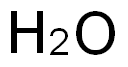
- 7732-18-5
- H2O
- 18.01
- All (50)
- China (13)
- (50)
Related Products More >

- 9003-05-8
- USD 30.0000
- 25kg
- 9003-05-8
- USD 30.0000
- 25kg
- 1336-21-6
- CNY 500.0000
- 1ton
- 7758-99-8
- USD 3000.0000
- 25kg


A key attribute of this aqueous solution is its ability to conduct electricity, as it fully dissociates into mobile Cu²⁺ and SO₄²⁻ ions. This ionic nature is leveraged in practical applications such as electroplating baths, where it serves as a source of copper ions for depositing a thin, uniform layer of copper onto surfaces. The dissolution process is also exothermic, releasing a noticeable amount of heat, which is consistent with the high hydration enthalpy of the small and highly charged copper(II) ion.
In agriculture, this solubility is fundamental for creating Bordeaux mixture, a fungicide prepared by mixing copper sulfate solution with slaked lime. This mixture effectively controls fungal diseases on crops like grapes and potatoes, as the dissolved copper ions disrupt enzyme functions in fungal spores. Similarly, in educational laboratories, the easy preparation of a clear copper sulfate solution is frequently employed to demonstrate crystallization processes, electrochemistry, and as a reagent in various qualitative analysis tests, making it a staple compound for foundational chemistry experiments.
In analytical chemistry, the solubility of copper sulfate is foundational for quantitative procedures like titrations, where it can act as a source of Cu²⁺ ions for reactions with reducing agents. Its solubility also distinguishes it from similar compounds; for example, copper sulfide (CuS) is highly insoluble in water due to the strong covalent character in its bonds, which resists hydration. This difference is critical in qualitative analysis, where solubility behavior helps identify metal ions in a sample. Unlike some insoluble copper compounds that require acidic conditions to dissolve, copper sulfate dissolves readily in pure water, making it versatile for applications ranging from electroplating baths to agricultural fungicides, where its aqueous solutions can be easily prepared and applied.
A common misconception is that all copper compounds share the same solubility properties, but copper sulfate’s behavior is specific to its ionic composition. For instance, copper(II) hydroxide (Cu(OH)₂) is only slightly soluble in water and forms a precipitate, whereas copper sulfate dissolves completely in adequate water. This distinction matters in practical scenarios, such as water treatment, where using an insoluble copper compound would not effectively release Cu²⁺ ions for algae control, whereas soluble copper sulfate can distribute the ions evenly through the water. Understanding this solubility also prevents errors in laboratory work, where assuming similar behavior between copper compounds could lead to incorrect experimental setups or misinterpretation of results.
From a practical standpoint, this solubility underpins its diverse applications. In agriculture, aqueous copper sulfate solutions are employed as fungicides, algaecides, and soil amendments, relying on its ability to disperse evenly in irrigation or pond water. Industrially, its solubility allows it to participate in electroplating, chemical synthesis, and as a reagent in analytical chemistry where precise concentrations are critical. The interaction with water also affects its storage and handling, as exposure to moisture can lead to partial dissolution or caking of the solid form, altering its intended concentration for use.
On a chemical and physiological level, the dissociation of copper sulfate in water releases free copper ions, which are biologically active and can interact with proteins and enzymes. While this contributes to its effectiveness in controlling microbial growth, it also requires careful consideration regarding environmental and human exposure, as elevated concentrations can be toxic to aquatic life and harmful if ingested in large quantities. Understanding the solubility behavior of copper sulfate allows for controlled application, whether in small-scale laboratory experiments or large-scale agricultural treatments, ensuring its benefits are maximized while minimizing unintended effects.
The interplay between copper sulfate and water also highlights broader principles in chemistry, demonstrating how ionic compounds interact with polar solvents. This behavior informs educational demonstrations, laboratory techniques, and industrial practices, offering a clear example of solubility dynamics in everyday chemical systems.