


 Home
Home
Hi, I'd like to ask—Is polyethylene a polymer? What monomers is it polymerized from? What are the characteristics of its molecular structure? How does it differ from other polymers (such as PVC)? How do the polymeric properties of polyethylene affect its uses? Thanks!
Is Polyethylene a Polymer and What Is Its Molecular Structure?
Related Encyclopedia
- 25213-02-9
- C8H16
- 112.21264
- All (24)
- China (2)
- (24)
- 9002-88-4
- (C2H4)n
- 28.05316
- All (24)
- China (2)
- (24)
- 63231-66-3
- C4H7Cl
- 90.55138
- All (3)
- China (3)
- (3)
- 68131-73-7
- C12H5N7O12
- 0
- All (2)
- China (0)
- (2)
- 68441-17-8
- C51H102O21Si2
- 0
- All (29)
- China (28)
- (29)
- 64754-90-1
- 0
- All (3)
- China (3)
- (3)
- 25322-68-3
- (C2H4O)nH2O
- 0
- All (65)
- China (33)
- (65)
- 28287-76-5
- C2H5O2
- 61.05990
- All (65)
- China (33)
- (65)
- 25038-59-9
- C10H12O6
- 228.19868
- All (3)
- China (0)
- (3)

- 51252-84-7
- C3H4O2
- 72.06270
- All (0)
- China (0)
- (0)
Related Products More >

- 63231-66-3
- CNY Request For Quotation
- 9003-55-8
- CNY Request For Quotation
- 9002-88-4
- Request For Quotation
- 25322-68-3
- Request For Quotation


Compared to polymers like PVC (polyvinyl chloride), polyethylene lacks chlorine atoms in its backbone. PVC contains a chlorine substituent, which makes it more polar and prone to degradation under heat, potentially releasing harmful compounds. Polyethylene, composed purely of carbon and hydrogen, is chemically inert, non-toxic, and more stable across a range of temperatures. Its non-polar structure also makes it water-resistant and less reactive with most chemicals, distinguishing it from polar polymers like nylon or PET.
Polyethylene’s polymeric properties directly shape its applications. LDPE’s flexibility and ductility make it ideal for plastic bags, squeeze bottles, and shrink wraps, while HDPE’s rigidity and strength suit it for milk jugs, pipes, and detergent containers. Its low production cost, ease of molding, and resistance to moisture and chemicals drive its use in food packaging, medical tubing, and industrial liners. The absence of polar groups also makes it suitable for products requiring purity, such as pharmaceutical bottles and laboratory equipment.
The molecular structure of polyethylene can vary, leading to different types of the polymer. High-density polyethylene (HDPE) has a more linear and less branched structure, which contributes to its strength, rigidity, and resistance to chemicals. Low-density polyethylene (LDPE), on the other hand, has a more branched structure, making it more flexible and elastic. These structural differences significantly impact their applications. HDPE is commonly used in applications requiring durability, such as milk jugs, detergent bottles, and plastic pipes. LDPE, with its flexibility, is often used in plastic films, grocery bags, and flexible packaging materials.
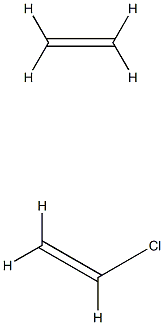
When compared to other polymers, such as polyvinyl chloride (PVC), polyethylene's properties stand out. PVC is derived from vinyl chloride monomer (C2H3Cl) and contains chlorine atoms in its structure. This chlorine component gives PVC increased rigidity and resistance to UV degradation, making it suitable for applications like plumbing pipes and window frames. Polyethylene, lacking chlorine and having a simpler hydrocarbon structure, is more chemically inert and less prone to degradation under UV light. However, it is generally less rigid than PVC.
The polymeric properties of polyethylene, particularly its density and crystallinity, greatly influence its uses. HDPE, with its high crystallinity, is known for its strength and durability. LDPE, with its lower crystallinity and more amorphous structure, is more flexible. These properties allow polyethylene to be tailored for specific industrial and consumer needs. For example, HDPE's strength makes it ideal for fuel tanks and industrial containers, while LDPE's flexibility is perfect for packaging materials.
In the context of international trade, polyethylene is a significant commodity. Its versatility and ease of production make it a valuable material in various industries. The differences in polyethylene types and their properties mean that specific grades are traded for particular applications. HDPE is often sought for its durability in packaging and construction, while LDPE is in demand for its flexibility in consumer packaging.
Once I compared it to PVC and noticed how different they are. PVC has chlorine atoms, making it stiffer but also heavier. Polyethylene’s just carbon and hydrogen, so it’s lighter and doesn’t leach harmful stuff. That’s why my water bottle is HDPE—it’s tough and safe. My lab partner uses LDPE bags for storing reagents because they’re flexible. It’s wild how small structural differences mean one’s for pipes and the other’s for sandwich bags.
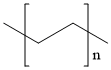
The molecular structure of polyethylene consists of repeating -CH2- units arranged in either linear or branched configurations. HDPE features a highly ordered, crystalline structure with minimal branching, which contributes to its high density, strength, and rigidity. In contrast, LDPE contains numerous side branches that disrupt the packing of polymer chains, resulting in lower density, increased flexibility, and reduced crystallinity. This structural variation directly influences the material's mechanical properties, thermal behavior, and chemical resistance. For example, HDPE has a higher melting point and tensile strength compared to LDPE, making it suitable for more demanding applications.
When compared to other polymers such as polyvinyl chloride (PVC), polyethylene exhibits distinct characteristics. PVC contains chlorine atoms in its molecular backbone, which impart rigidity, flame retardancy, and chemical resistance but also introduce environmental and health concerns due to the presence of chlorine. Polyethylene, on the other hand, lacks polar functional groups, making it chemically inert, non-toxic, and highly resistant to moisture and many chemicals. While PVC is typically stiffer and more brittle, it can be modified with plasticizers to enhance flexibility. Polyethylene's flexibility is inherent to its molecular structure, eliminating the need for such additives.
The polymeric properties of polyethylene significantly influence its applications across various industries. HDPE's strength and chemical resistance make it ideal for rigid containers, pipes, and industrial tanks. Its food-safe nature and low moisture absorption suit it for packaging applications such as milk jugs and detergent bottles. LDPE's flexibility and toughness are perfect for plastic bags, shrink wrap, and flexible tubing. Specialized grades like ultra-high-molecular-weight polyethylene (UHMWPE) exhibit exceptional wear resistance, finding use in medical implants and industrial wear parts. Unlike PVC, which often requires additives for specific properties, polyethylene's inherent characteristics often simplify processing and enhance safety. Its recyclability, cost-effectiveness, and ease of thermoplastic processing through methods like extrusion and injection molding further contribute to its widespread use in packaging, construction, and consumer goods.