


 Home
Home
Rubber is a flexible material used in all kinds of products, from gloves to gaskets. But sometimes, you may need to shrink it—maybe it's stretched out or doesn’t fit properly anymore. Can regular heat help? Does the type of rubber make a difference, or is water involved somehow? What’s the easiest way to shrink rubber at home without ruining it or making it too brittle?
How to Shrink Rubber Without Damaging It?
Related Encyclopedia
- 9006-04-6
- C5H8
- 68.11702
- All (0)
- China (0)
- (0)

- 7704-34-9
- S8
- 256.52
- All (4)
- China (4)
- (4)
- 12185-12-5
- S2
- 63.94410
- All (4)
- China (4)
- (4)
- 63148-67-4
- C23H29NO3
- 367.48126
- All (0)
- China (0)
- (0)
- 9010-85-9
- C9H16
- 124.23
- All (2)
- China (0)
- (2)
- 9002-85-1
- C2H2Cl2
- 96.94
- All (0)
- China (0)
- (0)
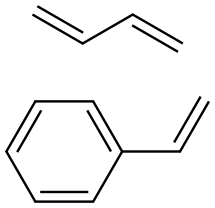
- 9003-55-8
- (C8H8.C4H6)x
- 158.24
- All (5)
- China (1)
- (5)
- 65952-74-1
- C12H8N6S
- 268.29700
- All (0)
- China (0)
- (0)
- 1177730-84-5
- O4S
- 96.06260
- All (0)
- China (0)
- (0)

- 66106-90-9
- I2S
- 285.87400
- All (0)
- China (0)
- (0)
Related Products More >

- CNY Request For Quotation
- CNY Request For Quotation
- CNY Request For Quotation
- CNY Request For Quotation
- CNY Request For Quotation
- CNY Request For Quotation
- CNY Request For Quotation
- CNY Request For Quotation


But here’s the thing—not all rubber shrinks the same. Natural rubber responds better than synthetic kinds. And if you heat it too much, it might become brittle or even melt, so it’s good to test with short soak times first. You can also try using a hair dryer for more control, especially on smaller areas.
So yes, rubber can shrink, but gently heating it is the safest trick. Just be careful not to overdo it. Have you tried this before, or are you working with something more delicate?
Another method involves chemical treatments, though less common for everyday use. Certain solvents can temporarily soften rubber, making its structure more malleable; when the solvent evaporates, the polymer chains settle into a smaller configuration. For example, some rubber gaskets used in plumbing are treated with mild solvents during manufacturing to ensure they shrink to fit tightly around pipes, preventing leaks.
It’s important to note that not all rubber shrinks uniformly. Factors like the type of polymer, degree of cross-linking, and duration of treatment affect the outcome. For instance, latex rubber, with its high elasticity, may shrink more noticeably under heat than a heavily cross-linked synthetic rubber like EPDM, which is designed for stability. Understanding these variables helps in applying the right method—whether using a hair dryer to shrink a loose rubber seal or relying on industrial processes for precision components.
From a molecular perspective, rubber consists of long-chain elastomers, often crosslinked by vulcanization using sulfur or other agents. This crosslinking imparts rubber with its elastic memory—the tendency to revert to its original shape after deformation. When heat is applied, the energy increases chain mobility, and if the rubber was previously stretched or deformed, the chains may relax into a tighter configuration upon cooling. This controlled relaxation leads to observable shrinkage. In vulcanized rubber, the extent of shrinkage depends heavily on the degree of crosslinking, the composition (natural vs. synthetic), and the temperature threshold reached.
In industrial settings, the ability to shrink rubber is used in applications such as heat-shrink tubing for electrical insulation, where precision and durability are critical. In the medical field, rubber's shrinkage properties are important in device seals and certain implants, where body temperature triggers gradual contraction. In everyday life, people encounter this when rubber bands tighten after being dipped in hot water or when rubber components in machinery shift dimensions due to repeated heating and cooling cycles.
Interdisciplinary insights from chemistry, materials science, and physics reveal that the thermal and mechanical responses of rubber are also influenced by environmental factors such as humidity, pressure, and chemical exposure. For instance, rubber exposed to oils or UV radiation may not shrink predictably, as degradation alters its molecular structure.
Understanding how and why rubber shrinks goes beyond practical adjustments—it touches on the broader study of polymer thermodynamics and materials behavior. This knowledge helps engineers design longer-lasting products, assists medical professionals in selecting the right materials for dynamic environments, and informs everyday users about the limitations and potentials of rubber in daily use.
Another approach involves solvent exposure, where certain chemicals weaken the polymer network, causing the rubber to swell temporarily before shrinking as the solvent evaporates. This method is useful in repairing or resizing rubber products, such as shoe soles or hoses. However, excessive heat or harsh chemicals can degrade the material, reducing its durability. A practical example is the use of boiling water to shrink rubber tubing for a tighter seal in plumbing applications. The temperature must be carefully controlled to avoid compromising the rubber’s integrity.
The interplay between temperature, time, and material composition determines the effectiveness of shrinkage. Natural rubber behaves differently from synthetic variants like neoprene or silicone, each requiring tailored methods. Understanding these dynamics ensures practical applications, from customizing rubber parts in engineering to crafting durable consumer goods. Mastery of these techniques balances precision with material preservation, highlighting rubber’s versatility as a responsive, adaptable material.