


 Home
Home
Hello, please explain what specific circumstances might lead to misunderstandings about its ban, why regulatory bodies generally deem it safe, what are the detailed European regulatory policies regarding its use, and in which particular products is its use restricted or prohibited and why?
Why Is Propylene Glycol Banned in Europe? The Truth Behind the Regulatory Restrictions
Related Encyclopedia
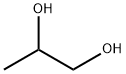
- 57-55-6
- C3H8O2
- 76.09
- All (326)
- China (55)
- (326)
- 26402-31-3
- C21H40O4
- 356.54000
- All (0)
- China (0)
- (0)
- 118624-10-5
- C9H18O7
- 238.23500
- All (0)
- China (0)
- (0)

- 53824-77-4
- C23H44O4
- 384.59300
- All (0)
- China (0)
- (0)
- 112071-94-0
- C9H16O5
- 204.22000
- All (0)
- China (0)
- (0)
- 31565-12-5
- C11H22O3
- 202.29058
- All (0)
- China (0)
- (0)

- 41395-83-9
- C21H40O4
- 356.54000
- All (0)
- China (0)
- (0)
- 25791-96-2
- HO(C3H6O)nCH[CH2(OC3H6)nOH]2
- 0
- All (4)
- China (2)
- (4)
- 64217-62-5
- C21H26N6O7S2
- 538.60000
- All (1)
- China (1)
- (1)

- 105-62-4
- C39H72O4
- 604.99
- All (1)
- China (0)
- (1)
Related Products More >

- CNY Request For Quotation
- CNY Request For Quotation
- CNY Request For Quotation
- 110-98-5
- CNY Request For Quotation
- 110-98-5
- CNY Request For Quotation
- 25322-69-4
- Request For Quotation
- 25322-69-4
- Request For Quotation
- 24800-44-0
- CNY 10.0000
- 25kg


In terms of regulatory policies, the European Union has set limits on the amount of propylene glycol in various products. For example, in foodstuffs and beverages, the maximum allowed is 3 grams per kilogram, much lower than the 50 grams per kilogram permitted in the US. This shows Europe's cautious approach to protect public health.
It is banned in specific products where its risks outweigh its benefits. In some countries like Norway, Sweden, and Finland, certain batches of Fireball Whisky were recalled because they contained higher levels of propylene glycol than what is allowed in Europe. Also, in the pharmaceutical industry, due to contamination issues related to similar substances like ethylene glycol and diethylene glycol, strict monographs are in place for propylene glycol to ensure product safety.
Propylene glycol is used in food, cosmetics, pharmaceuticals, and as an antifreeze in systems that may come into contact with potable water or food. Its safety profile allows it to be included in products such as e-cigarettes, food flavorings, and certain medications. The European Union regulates its use in these products through specific directives and regulations ensuring its safe application.
In terms of automotive and HVAC applications, propylene glycol is favored for its lower toxicity when there's a risk of accidental ingestion or spillage. For instance, in environments where pets, wildlife, or children could potentially access the coolant, propylene glycol presents a safer alternative to ethylene glycol.
Therefore, the key point here centers around the regulation, safety, and versatility of propylene glycol. Misconceptions about bans may arise from confusion with other substances or outdated information. Understanding the proper regulatory framework and safety guidelines associated with propylene glycol is crucial for its effective and safe use across different sectors in Europe and beyond. This discussion highlights the importance of accurate information regarding chemical safety and regulations to ensure both compliance and effective application of substances like propylene glycol.
Why Europe Restricts Propylene Glycol
Health Concerns:
Potential skin sensitization (allergic reactions in 0.8-3.5% of patch-tested individuals)
Respiratory irritation risks in vaping products (under EC 1272/2008 CLP regulation)
Environmental Policies:
REACH regulation classifies PG as a "Substance of Very High Concern" (SVHC) when used in aerosols
Biodegradability: PG breaks down slowly in aquatic environments (50% degradation in 28 days)
Precautionary Principle:
EU prioritizes caution over unproven long-term safety (especially in cosmetics and food)
EU Regulatory Policies on Propylene Glycol
Regulation
Restriction Scope
Key Limits
EC 1223/2009 (Cosmetics)
Leave-on products
≤1% in products for damaged skin
EU 10/2011 (Food Contact)
Plastic food packaging
≤0.05% migration limit
Tobacco Products Directive
E-cigarette liquids
Mandatory ingredient disclosure
REACH Annex XVII
Industrial applications
Restricted in aerosol propellants
Critical notes:
No blanket ban: PG remains permitted in most applications at safe levels
Country variations: Denmark imposes stricter limits than EU-wide rules
Products Where PG Faces Bans/Restrictions
Cosmetics for Children Under 3
Banned in diaper creams/lotions in France (2022)
Leave-On Skincare for Eczema
EU caps at 1% concentration
E-Cigarette Liquids in Some Markets
Netherlands limits PG to 60% of e-liquid volume
Aerosol Air Fresheners
Phased out under EU Volatile Organic Compounds (VOC) Directive
Organic-Labeled Foods
Prohibited in EU organic food production (EC 834/2007)