


 Home
Home
Hi, I'd like to ask—What specific voltage or resistance range should the multimeter be set to when checking an oxygen sensor? How to correctly connect the multimeter probes to the oxygen sensor's wiring harness? What voltage fluctuations indicate a normally working oxygen sensor? What readings suggest the sensor is faulty, such as being contaminated or aged? Can a multimeter detect all possible faults of the oxygen sensor, or are there limitations? Also, do I need to start the engine during the test, and are there any safety precautions to take? Thanks!
How to properly check an oxygen sensor using a multimeter?
Related Encyclopedia

- 7782-44-7
- O2
- 32
- All (1)
- China (1)
- (1)

- 80937-33-3
- O2
- 31.99880
- All (1)
- China (1)
- (1)

- 17410-58-1
- O2
- 33.99860
- All (1)
- China (1)
- (1)
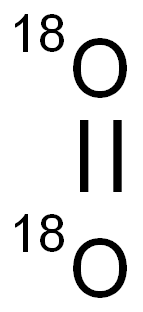
- 32767-18-3
- O2
- 36
- All (0)
- China (0)
- (0)
- 112270-21-0
- C7H10O
- 124.14000
- All (0)
- China (0)
- (0)

- 16833-27-5
- O
- 15.99940
- All (0)
- China (0)
- (0)
- 50412-08-3
- C6H6O
- 94.11120
- All (0)
- China (0)
- (0)
- 80345-87-5
- Cu2O2
- 159.09100
- All (0)
- China (0)
- (0)

- 67321-81-7
- O2
- 33.99830
- All (0)
- China (0)
- (0)
- 866954-14-5
- Cu5O2
- 349.72900
- All (0)
- China (0)
- (0)
Related Products More >

- 9059-23-8
- Request For Quotation
- 9002-10-2
- Request For Quotation
- Bottle,barrel,cargo,container,etc.
- 82419-35-0
- Request For Quotation
- 82419-35-0
- Request For Quotation
- 82419-35-0
- Request For Quotation
- 7782-44-7
- Request For Quotation
- 40L/Cylinder, ISO tank
- 54029-12-8
- Request For Quotation
- 20243-59-8
- Request For Quotation


To connect the probes: Locate the signal wire (often black, blue, or gray in the harness). Attach the multimeter’s positive probe to this wire and the negative probe to a clean metal ground (e.g., engine block or chassis). For the heater circuit, connect probes to the two heater wires (commonly white or red) to check resistance.
A functional oxygen sensor shows voltage fluctuations between 0.1V (lean mixture) and 0.9V (rich mixture), cycling every 1-2 seconds once the engine is warm. Faulty sensors may display fixed readings (e.g., stuck at 0.1V or 0.9V), slow fluctuations (over 5 seconds), or no change, indicating contamination or aging.
A multimeter has limitations: it cannot detect cracks in the sensor element, slow response under load, or intermittent faults. Yes, start the engine and let it warm to operating temperature (10-15 minutes) for accurate results. Safety precautions include engaging the parking brake, avoiding hot exhaust parts to prevent burns, using insulated probes to avoid short circuits, and keeping tools clear of moving components like belts or fans.
When connecting the multimeter probes, first identify the sensor's signal wire from the wiring diagram - usually the middle wire in a four-wire narrowband sensor configuration. Connect the positive probe to the signal wire and the negative probe to a good ground point on the vehicle chassis. For testing the heater circuit, switch to ohmmeter mode and measure resistance between the heater power wire and ground, with typical values ranging from 2 to 10 ohms depending on the sensor model.
A properly functioning narrowband oxygen sensor should show rapid voltage fluctuations between 0.1V and 0.9V when the engine is at operating temperature, indicating active air-fuel ratio feedback control. A reading that remains stuck at either extreme (consistently near 0.1V or 0.9V) suggests the sensor may be contaminated with silicone from coolant leaks or carbon deposits from rich running conditions. A completely flat reading (0V or 1V) often indicates an open circuit in the signal wire or a failed sensor element.
While multimeters can detect basic electrical faults in oxygen sensors, they have limitations. They cannot measure response time dynamics or detect slow degradation that affects sensor performance but doesn't completely fail the electrical test. For comprehensive diagnosis, a scan tool that can monitor live data and perform bidirectional tests is recommended.
Safety precautions are essential when performing this test. Always disconnect the battery before working on electrical systems to prevent short circuits. Ensure the engine is cool before touching exhaust components, as they can remain dangerously hot for hours after shutdown. When running the engine for dynamic testing, work in a well-ventilated area to avoid exposure to exhaust gases, which contain toxic levels of carbon monoxide.
A properly functioning oxygen sensor should display fluctuating voltage readings when the engine is running and at operating temperature. The voltage should switch smoothly between the lean and rich values, typically cycling between 0.1 and 0.9 volts several times per second. This fluctuation indicates the sensor is correctly responding to changes in the exhaust gas composition. If the voltage reading remains stuck at a single value, either near 0.45 volts or at one of the extremes, this suggests the sensor may be faulty. A reading that shows no voltage at all could indicate either a failed sensor or a wiring problem.
Several abnormal readings can point to a defective oxygen sensor. If the voltage remains constantly high (above 0.8 volts) or low (below 0.2 volts), the sensor might be contaminated with silicone from sealants or coolant from a leaking head gasket. An excessively slow response rate, where the voltage takes several seconds to change between lean and rich values, often indicates an aged sensor that needs replacement. When testing the heater circuit, an open circuit (infinite resistance) or a reading significantly outside the specified range confirms a heater failure.
While a multimeter can detect many common oxygen sensor problems, it has limitations. It cannot measure the sensor's response time dynamics precisely or detect intermittent faults that only occur under specific operating conditions. For comprehensive testing, especially of the sensor's response characteristics, a scan tool that can monitor live data is more appropriate.
Engine operation is necessary for meaningful voltage testing since the sensor only generates signals when exposed to hot exhaust gases. Before starting any tests, ensure the engine is at normal operating temperature. Safety precautions include disconnecting the battery before working on electrical components to prevent short circuits, allowing the exhaust system to cool before handling sensors, and using insulated tools to avoid electrical shocks. Always refer to the vehicle's service manual for the exact wiring diagram and specifications, as oxygen sensor configurations can vary significantly between different makes and models.
A working oxygen sensor shows quick voltage changes between 0.1V and 0.9V, fluctuating at least 4-5 times per second. This back-and-forth indicates it’s properly monitoring the air-fuel mixture. If the voltage stays steady, say always above or below 0.45V, or changes very slowly, the sensor might be faulty.
A multimeter can’t catch everything, though. It won’t detect slow response times in aged sensors or issues with the heater circuit. For those, a scan tool might be needed. You do need to start the engine, letting it warm up to operating temperature—about 5-10 minutes.