


 Home
Home
Last week at the lab, one of my friends was cleaning up after an experiment and stumbled across a bottle labeled 4-isopropylphenol. She looked up, squinting at the label, and asked, “Hey, is 4-isopropylphenol acidic or basic?” Great question, right?
Is 4-Isopropylphenol Acidic or Basic?
Related Encyclopedia
- 150188-64-0
- C10H13NO3
- 195.22
- All (0)
- China (0)
- (0)
- 2971-31-5
- C10H9NO3
- 191.18
- All (0)
- China (0)
- (0)
- 89-83-8
- C10H14O
- 150.22
- All (37)
- China (15)
- (37)
- 6710-83-4
- C3H6N2O2
- 102.09200
- All (0)
- China (0)
- (0)
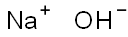
- 1310-73-2
- NaOH
- 39.99711
- All (130)
- China (116)
- (131)
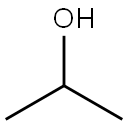
- 67-63-0
- C3H8O
- 60.1
- All (13)
- China (13)
- (13)
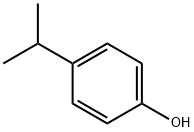
- 99-89-8
- C9H12O
- 136.19
- All (3)
- China (3)
- (3)

- 12200-64-5
- H3NaO2
- 58.01240
- All (0)
- China (0)
- (0)
- 87331-12-2
- HNa3O
- 85.97670
- All (0)
- China (0)
- (0)
- 389873-17-0
- HNaO
- 40.99680
- All (0)
- China (0)
- (0)
Related Products More >

- CNY Request For Quotation
- CNY Request For Quotation
- 64-19-7
- Request For Quotation
- 67-63-0
- Request For Quotation
- 1310-73-2
- Request For Quotation
- 1310-73-2
- Request For Quotation
- 1310-73-2
- Request For Quotation
- 67-63-0
- USD 1.0000
- 160kg


4-Isopropylphenol has a phenol structure (benzene ring + -OH) but with an isopropyl group (-C₃H₇) attached. Phenol itself is weakly acidic (pKa ~10), as the -OH can partly ionize. However, the isopropyl group here acts as a electron-donating group, which reduces acidity. It’s like adding a “shield” that makes the -OH hold onto its H⁺ tighter.
Compare this to chlorophenol, where a electron-withdrawing Cl increases acidity. In contrast, 4-isopropylphenol’s acidity is weaker than plain phenol. So, is it acidic? Yes—but barely. Its pKa is higher than phenol, meaning it’s less likely to donate H⁺. Would it turn litmus blue? Unlikely. More neutral, really.
Why Acidic? The “Phenol Power”
Hydroxyl Group Drama: The -OH group on the benzene ring loses H⁺ ions easily. The oxygen grabs the benzene’s electrons, stabilizing the negative charge after losing H⁺—like a chaiwala balancing six cups at once!
Isopropyl Effect: The bulky isopropyl group (C₃H₇) attached to the ring is an electron donor. This slightly reduces acidity compared to plain phenol. Think of it as adding extra sugar to lemonade—it’s still tangy but less sharp!
Comparison:
Phenol (C₆H₅OH): pKa ≈ 10
4-isopropylphenol: pKa ≈ 10.5 (less acidic)
Ethanol (C₂H₅OH): pKa ≈ 16 (way less acidic)
Applications: Where Is It Used?
Disinfectants: Weak acidity helps kill microbes (but not as strong as phenol).
Chemical Synthesis: Used to make antioxidants, plastics, and dyes.
Pharma: Intermediate in drug manufacturing (e.g., painkillers).
Safety Tips (Don’t Be a Jugaadu Chemist!)
Skin Contact: Acidic = corrosive! Wear gloves—no “chalta hai” attitude.
Storage: Keep away from metals like sodium (reacts to release flammable H₂ gas).
Disposal: Neutralize with mild bases (e.g., baking soda) before dumping.
Why Not Basic?
Bases (like NaOH) accept H⁺ ions. But 4-isopropylphenol’s -OH group is stuck on the benzene ring—it can’t grab extra H⁺. It’s like a vada pav without chutney—missing the kick!
Fun Fact
If you replace the -OH group with -NH₂ (amine), it becomes basic! But that’s a different molecule—4-isopropylaniline.
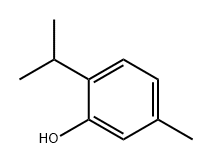
So why does this matter? Well, 4-isopropylphenol, also known as p-isopropylphenol, is a compound used in various industrial and chemical applications, like making disinfectants and in the synthesis of more complex molecules. It’s structurally related to thymol, which you might recognize from mouthwash and antiseptics.
As for human health, exposure to concentrated 4-isopropylphenol can irritate the skin and respiratory system. In terms of environmental impact, like most phenolic compounds, it's toxic to aquatic life and needs to be handled with care. In industrial settings, it's important to control emissions and waste streams to prevent contamination.
This property makes phenols weakly acidic. While not as strong as carboxylic acids, 4-isopropylphenol can react with strong bases (e.g., NaOH) to form salts. The isopropyl substituent is an electron-donating group, which slightly decreases the acidity compared to phenol itself, but the compound remains acidic overall due to the phenolic structure.