


 Home
Home
The original question "is ba o ionic" seems to be asking whether the compound BaO (barium oxide) is ionic in nature. is Barium oxide indeed an ionic compound?
Is BaO Ionic? Understanding Its Ionic Nature and Applications
Related Encyclopedia
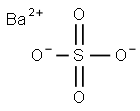
- 7727-43-7
- BaO4S
- 233.39
- All (261)
- China (18)
- (261)
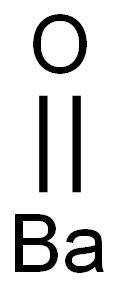
- 1304-28-5
- BaO
- 153.33
- All (2)
- China (1)
- (2)
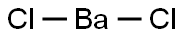
- 10361-37-2
- BaCl2
- 208.23
- All (18)
- China (13)
- (18)
- 12323-41-0
- CaO
- 58.07720
- All (164)
- China (21)
- (164)
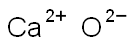
- 73018-51-6
- CaO
- 56.08
- All (164)
- China (21)
- (164)
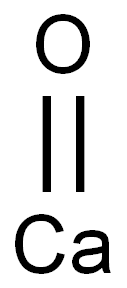
- 1305-78-8
- CaO
- 56.08
- All (164)
- China (21)
- (164)
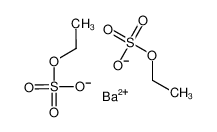
- 6509-22-4
- C4H10BaO8S2
- 387.57400
- All (0)
- China (0)
- (0)
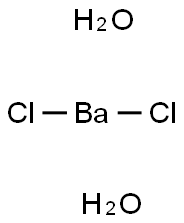
- 10326-27-9
- BaCl2H4O2
- 244.26
- All (53)
- China (0)
- (53)
- 188528-77-0
- Ca2O2
- 112.15500
- All (0)
- China (0)
- (0)
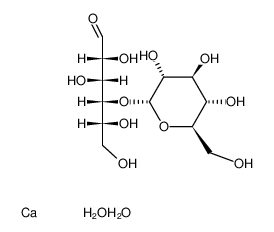
- 36570-80-6
- C12H26CaO13
- 422.43700
- All (0)
- China (0)
- (0)
Related Products More >

- 1305-78-8
- USD 135.0000
- 1ton
- 10361-37-2
- CNY 2650.0000
- 1ton
- 73018-51-6
- Request For Quotation
- 500g
- 73018-51-6
- Request For Quotation
- 100g
- 73018-51-6
- Request For Quotation
- 10g
- 73018-51-6
- Request For Quotation
- 10ton
- 73018-51-6
- Request For Quotation
- 495ton
- 73018-51-6
- Request For Quotation
- 1kg


In the chemical industry, BaO is used in various applications due to its ionic nature. For example, in the production of certain types of glass, BaO can be added to modify the properties of the glass. The ionic bonds in BaO allow it to interact with the silica network in glass, affecting its refractive index, melting point, and chemical durability. In a laboratory setting, BaO can be used in reactions where its ionic properties enable it to participate in ion - exchange reactions or as a basic oxide to react with acids.
In daily life, although direct contact with pure BaO is rare, understanding its ionic nature is still relevant. For instance, barium - containing compounds are sometimes used in medical imaging. Barium sulfate (BaSO₄), which also has ionic characteristics, is used as a contrast agent in X - ray procedures.
When considering the use or operation involving BaO, several precautions should be taken. BaO is a hygroscopic compound, meaning it readily absorbs moisture from the air. This can lead to the formation of barium hydroxide, which is caustic. So, it should be stored in a dry environment. Also, due to its reactivity, it should be kept away from substances that can react with it, such as acids. When handling BaO, appropriate personal protective equipment, including gloves and goggles, should be worn to prevent skin and eye contact, as it can cause irritation and chemical burns.
Explanation
To understand why BaO is classified as an ionic compound, we need to look at the elements that constitute it. Barium (Ba) is a metal from Group 2 of the periodic table, while oxygen (O) is a non-metal from Group 16. The difference in electronegativity between barium and oxygen is substantial, with oxygen being much more electronegative than barium. This significant difference in electronegativity leads to the transfer of electrons from barium to oxygen, resulting in the formation of ions.
In BaO, barium loses two electrons to form a Ba²⁺ cation, while oxygen gains these two electrons to form an O²⁻ anion. The electrostatic attraction between the positively charged barium ions and the negatively charged oxygen ions forms the ionic bond. This type of bonding is characteristic of ionic compounds, which typically consist of metals and non-metals.
The ionic nature of BaO can also be inferred from its physical properties. Ionic compounds generally have high melting and boiling points due to the strong electrostatic forces between the ions. BaO melts at around 1923°C and boils at around 2000°C, which are consistent with the properties of ionic compounds. Additionally, BaO is brittle and conducts electricity when molten or in aqueous solution, further confirming its ionic nature.
Case Study: Application in the Chemical Industry
One of the primary applications of barium oxide is in the manufacturing of cathode ray tubes (CRTs) for televisions and computer monitors. In CRTs, BaO is used as a component of the phosphor coating on the inside of the screen. When electrons strike the phosphor, it emits light, creating the images we see on the screen. The ionic nature of BaO allows it to interact effectively with other compounds to produce the desired luminescent properties.
Another significant use of BaO is in the production of glass. Barium oxide is added to glass formulations to increase the refractive index and density of the glass. This property is particularly useful in the manufacture of optical glass, where high precision and clarity are required. The addition of BaO also improves the chemical durability of the glass, making it more resistant to environmental factors.
In the field of ceramics, BaO is used as a flux to lower the melting point of other materials, facilitating the formation of glassy phases and improving the mechanical properties of the final product. Its ionic nature allows it to interact effectively with other ceramic materials, enhancing their overall performance.
Precautions During Operation or Use
When handling barium oxide, it is essential to take several precautions due to its potentially hazardous nature:
Toxicity: Barium compounds, including BaO, can be toxic if inhaled, ingested, or if they come into contact with the skin. It is crucial to wear appropriate personal protective equipment (PPE), including gloves, safety goggles, and a dust mask, when handling BaO.
Ventilation: Work in a well-ventilated area or use a fume hood to avoid inhaling any dust or fumes generated during the handling of BaO.
Storage: Store BaO in a cool, dry place in a tightly sealed container to prevent moisture absorption and contamination. Ensure that the container is labeled appropriately and stored away from incompatible substances.
Disposal: Dispose of any waste containing BaO in accordance with local regulations and guidelines. Do not dispose of it in regular trash or pour it down the drain, as it can be harmful to the environment.
Emergency Procedures: In case of spillage, clean it up immediately using appropriate methods and equipment. If there is accidental contact with skin or eyes, rinse thoroughly with water and seek medical attention if necessary.
BaO stands for barium oxide, and it’s made up of two elements: barium (Ba) and oxygen (O). Now, barium is a metal — it’s one of those big, heavy metals hanging out in Group 2 of the periodic table (the alkaline earth metals). Oxygen, on the other hand, is a nonmetal. So right off the bat, when you’ve got a metal and a nonmetal together, chances are really high it’s an ionic compound.
Here’s the basic idea: barium has two electrons in its outer shell that it really, really wants to get rid of. Oxygen is sitting there wanting two extra electrons to fill up its own outer shell. So, barium straight-up gives oxygen those two electrons. When that happens, barium becomes a Ba²⁺ ion (positive charge because it lost electrons) and oxygen becomes an O²⁻ ion (negative charge because it gained electrons).
And boom — that opposite charge attraction pulls them together super tightly. That’s what an ionic bond is. It’s basically like magnets: positive and negative stick to each other.
Also, if you look at the properties of BaO, it totally acts like an ionic compound too. It’s solid at room temperature, it has a really high melting point, and if you dissolve it in water (careful though — it’s pretty reactive), it breaks apart into ions. That’s classic ionic behavior.
One more quick thing: BaO isn’t just sitting around harmlessly. It’s actually pretty basic (like, chemically basic, not "pumpkin spice latte" basic). When it reacts with water, it forms barium hydroxide, which is a strong base.
So yeah, long story short: BaO is 100% ionic. Metal + nonmetal, electrons being transferred, ions sticking together — textbook example of an ionic bond.
Hope that clears it up! Let me know if you wanna dive even deeper into it or talk about some cool uses for BaO too!